

“Every single crime committed by an illegal alien invader is preventable. Crime rates do not matter, only the raw number of crimes and the harm caused by those crimes.”
– Ken Cuccinelli, Former Attorney General of Virginia[i]
Murder is the worst crime – there’s no coming back from it. When your friends or loved ones are murdered, they’re gone forever and usually killed in a frightening, agonizing, painful way. Auto theft, burglary, muggings, and assault are all terrible crimes that keep Americans up into the wee hours of the morning. But murder is what keeps more of us up all night long and makes the headlines in major newspapers. “Homicide Rates Jump in Many Major U.S. Cities, New Data Shows,” reported The New York Times in 2016.[ii] “US records highest increase in nation’s homicide rate in modern history, CDC says,” reported CNN in 2021.[iii] “Homicide rates dropped in big cities. Why has the nation’s capital seen a troubling rise?” blared a USA Today headline in 2024.[iv] Murder headlines earn the clicks.
Kate Steinle’s tragic murder in San Francisco in 2015 isn’t the only case of an illegal immigrant committing murder. Mollie Tibbetts was a University of Iowa student murdered in 2018 by Cristhian Bahena Rivera, an illegal immigrant from Mexico. Laken Riley, another college student at the University of Georgia, was murdered by Venezuelan-born Jose Ibarra in Georgia in 2024.[v] Others were murdered by immigrants from 2015 through 2024, but there were over 200,000 murders during that time in the United States. What matters is whether immigrants are more or less likely to commit homicide than native-born Americans. All the evidence says that they are less likely to murder you than native-born Americans.
It’s the Crime Rates, Stupid
Ken Cuccinelli is the former Attorney General of Virginia who made a name for himself by suing the Obama Administration – sometimes to defend laws passed in other states, especially anti-immigration bills like the 2010 Arizona law. President Trump appointed Cuccinelli to be the Acting Director of U.S. Citizenship and Immigration Services (USCIS), but a judge ruled his appointment was illegal. That made Cuccinelli the undocumented head of an immigration agency.[vi]
Before and after his deportation from USCIS’ executive suite, Cuccinelli has said that immigrants are coming here to kill you. And he hasn’t let inconvenient things like math get in his way, such as when he says, “Crime rates do not matter.”[vii] No, Mr. Cuccinelli, crime rates are what matter. “Give me your tired and your poor who can stand on their own two feet and who will not become a public charge,” said Cuccinelli, putting his own spin on the poem engraved at the bottom of the Statue of Liberty.[viii] Here’s my rewording of Shakespeare’s Richard III to prove a point: “An attorney, an attorney, my kingdom for an attorney who can do math.”
Crime imposes a huge economic and psychological cost on people. The victims are those most directly hurt when criminals steal their property, assault them, or kill them. But the rest of us are psychologically and economically affected too. We may be more afraid to leave our houses at certain times, travel downtown, or interact with strangers on the streets or in dark alleyways. Crime destroys businesses, livelihoods, and lives themselves, and the fear of crime makes all our lives worse off by prompting us to change our behavior to avoid it. However, the crime rates tell us how dangerous crime is, not the number of crimes.
Crime rates adjust data based on population size, so you can compare the frequency of different crimes, which cities are the safest, and whether you should really go to Baltimore after dark. Most crime data show crimes per 100,000 residents, and the following doesn’t deviate from that style. Calculating the crime rate is straightforward but worth repeating for the benefit of any former state Attorneys General who may be reading this. First, you take the number of criminals or crimes committed. Second, you take the population you’re calculating the rate for. Third, you divide the number of crimes by the population. Lastly, you take that quotient and multiply it by 100,000 or whatever other number you want. Voila, a crime rate.
Further explanation may help, Ken. Below, there will be data on the illegal immigrant homicide conviction rates in Texas. This is calculated by dividing the number of illegal immigrants convicted of homicide by the total illegal immigrant population in Texas, multiplied by 100,000. The same math is then repeated for legal immigrants and native-born Americans with their respective numbers. Incarceration rates are calculated the same way – except they’re the number of prisoners divided by the population. It’s so easy that even former Attorneys General can do it.
Crime rates allow comparisons between crime levels in different cities, time periods, or groups—like immigrants and native-born Americans. Raw crime counts, the measure of criminality favored by Ken Cuccinelli, don’t consider population differences like the number of people in each group. The results of Cuccinelli’s preferred methods are absurd. Let’s use our imaginations.
Imagine a city with 100 murders a year. According to Cuccinelli’s naïve view, that city is twenty times more dangerous than a city with five murders. But if the city with 100 murders has a million residents and the city with five murders has only 100 residents, then the city with fewer murders is far more dangerous. How do we know? The city with one million residents and 100 murders has a homicide rate of 10 per 100,000. The city with 100 residents and five murders has a homicide rate of 5,000 per 100,000. Your odds of being murdered in the small city are 500 times greater than in the big city, even though five is a number smaller than 100. Why? Because the population is a lot bigger in the million-person city. Do I even need to ask you which city is safer?
Here’s a more tragic example: Detroit. Motor City’s population peaked at 1.8 million in 1950 and then slowly declined due to poor governance, a sclerotic American auto industry in Michigan, corrupt unions, and high taxes. Detroit’s population dropped by about a third during the 20-year mayorality of Coleman Young, whose governance style can best be summed up by the “M.F.I.C.” placard that he kept on his desk, short for “motherfucker in charge.”[ix] And, of course, the crime. Lots of crime.
Not just ordinary crime either. Race riots and urban chaos convinced many of the city’s prosperous and middle-class residents, mostly white, to flee to the suburbs. Those who didn’t leave were targeted by high progressive income taxes and commuter taxes pushed by Young and his political cronies who weren’t paid by Young’s poorer and blacker voting base.[x] By design, Young’s voters stayed in the city, and those who might vote against him left, while Young became politically unassailable and crime surged. Young earned the M.F. in M.F.I.C., but not the I.C. because the criminals were in charge.
From 1970 to 2023, the number of homicides in Detroit dropped from 495 to 252, a 49 percent decrease. Cucinelli – or anyone fixated on raw body counts – might call that an improvement. But it’s a numerical mirage. During that time, the homicide rate rose from 33 per 100,000 to 39 per 100,000, a 24 percent increase. The murder rate increased even though the number of murders fell because Detroit’s population declined even more from over 1.5 million in 1970 to about 640,000 in 2023, a decrease of 59 percent. Only considering murder, Detroit is a more dangerous city in 2023 than it was in 1970.[xi] Real mirages fool only the person wandering the desert. This numerical mirage was worse because it fooled Detroit’s police brass and surely would have fooled Cuccinelli, too.[xii]
Focusing on crime rates rather than the number of crimes is the only reasonable way to compare criminality between populations of different sizes, such as the 48 million immigrants and 287 million native-born Americans. Otherwise, there is no basis for arguing that one or the other is more criminally inclined, which is all that really matters when trying to understand whether immigrants are coming to kill us. After all, we must compare the threat from illegal immigrant murderers to something. That threat should be the chance of being killed by native-born murderers, rather than of being killed by cancer, old age, or bee stings. As an overrated economist once said, “In the long run we’re all dead.”[xiii] But immigrants are supposedly coming to kill us now.
Additionally, we couldn’t judge whether crime differs between geographical regions or over time without looking at crime rates because the number of crimes generally goes up as the population rises. It’s trivially easy to point to crimes committed by members of any large population, no matter how one defines it, but doing so reveals little. Looking at crime rates makes my job more challenging. I could end my substack series at the end of this paragraph if I accepted Cuccinelli’s way of measuring crime. Texas has the best immigrant crime data in the United States. From 2013 to 2022, 808 immigrants were convicted of homicide in Texas. During the same time, 7,109 native-born Americans were convicted of homicide – almost nine times as many![xiv] It really does look like native-born Americans are coming to kill you – maybe Trump had it backward? But such a take would be dishonest and, frankly, stupid.
Immigrants commit fewer murders in Texas because there are fewer immigrants. That is a trivial fact that tells you nothing about the relative rates of immigrant and native-born criminality because there are about five native-born Americans living in Texas for every immigrant. What we really care about is the crime rate. For every 100,000 immigrants, how many are murderers? If 100,000 illegal immigrants moved to your city, would your chances of being murdered rise or fall? And what’s the rate for native-born Americans and legal immigrants? Those are the comparisons that matter.
Everything is Bigger in Texas – Except the Illegal Immigrant Homicide Rate
Conservative columnist Ann Coulter has been a citizen of the commentariat since the late 1990s. She’s mostly followed the opinions of American conservatives by publishing books on their favorite topics like how bad Bill Clinton is, how she trusts Donald Trump, and how liberals are crazy, evil, godless, demonic, treasonous, guilty of bad things, or stupid. But she was ahead of the curve and helped change conservative minds with her 2015 book about how terrible immigrants are. ¡Adios, America! The Left’s Plan to Turn Our Country into a Third World Hellhole was released just 16 days before Trump gave his first nativist speech. Her television appearance on Jorge Ramos’ Fusion show probably influenced him.[xv] Most likely, when she said that immigrants are more dangerous than ISIS: “If you don’t want to be killed by ISIS, don’t go to Syria. If you don’t want to be killed by a Mexican, I don’t know what to tell you,” Coulter told Ramos.[xvi]
You can’t tell the topic of a Coulter book by its cover art because it’s always a younger picture of herself – even if the book is about Bill Clinton. Other than the plastic cover art, one section of ¡Adios, America! is memorable. Coulter writes that the U.S. government doesn’t have good statistics on immigrant criminals. The government has statistics on everything from the number of pigs on farms to ham radio operators, but it doesn’t keep statistics on the number of immigrant criminals.[xvii] Coulter fixates on individual criminals by illegal immigrants and insinuates a grand liberal conspiracy to hide the truth. She doesn’t even add Trump’s token disclaimer about how “some are good people.” In her telling, they must all be bad – why else would the government in fail to publish statistics? Did that elderly woman from Arizona speak with Coulter too?
Federal prisons have immigration data for federal crimes. In 2021, about 34 percent of those sentenced to federal prison were illegal immigrants.[xviii] Since illegal immigrants were only about 4.4 percent of the population in that year, that implies they are incarcerated well above their share of the population. Maybe they aren’t such good people after all! But federal prisons don’t give you the full picture because only about 10 percent of all prisoners nationwide are in federal prisons. And they’re special prisoners incarcerated for only federal crimes.
Almost all illegal immigrants in federal prison are incarcerated for drug smuggling and immigration offenses, which are crimes that account for almost half of all federal prisoners.[xix] There’s no federal crime for murder unless you commit it on federal property, kill a federal official, commit murder while crossing state lines, during a kidnapping, or as part of terrorism. Almost all murder convictions are prosecuted on the state level because that’s where the murder laws are. In 2021, only 313 people were sentenced to federal prison for murder or manslaughter – less than 1 percent of the total sentenced that year.[xx] Digging further into the data reveals that 281 of them were U.S. citizens and 32 were non-citizens, which includes legal immigrants, lawful travelers, those extradited to the United States, and illegal immigrants.
The small number of illegal immigrants sentenced to federal prison for homicide is a problem for Ken Cuccinelli’s way of counting crimes. Using the method preferred by the former Attorney General of the Commonwealth of Virginia, illegal immigrants don’t look so bad. A maximum of 32 homicide convictions? Time to call it a day. But we can’t fall into that innumerate trap. We must look at the relative homicide rates of immigrants and native-born Americans and include the rest of the American criminal justice system that resides in the states.
That’s a big job because, in 2021, there were about 175,600 people in state prisons for homicide and 2,426 in federal prisons.[xxi] Barely more than 1 percent of people convicted of homicide were sent to federal prison. And we cannot just look at all immigrants and compare them to native-born Americans, we must separate out illegal immigrants and calculate their crime rates separately. And this brings us back to Coulter’s challenge – why don’t we know?
Academics can indirectly answer that question. They have this problem where they investigate the questions they’re interested in and rarely pay attention to the questions that the rest of us have. They’ve investigated immigrant crime rates for over a century and keep finding the same results: immigrants have lower crime and incarceration rates than native-born Americans.[xxii] It doesn’t matter when or where, the result is the same in the United States. But when you say that, the response is always, “I believe that when it comes to legal immigrants, but what about illegal immigrants?” Good question.
Data from the American Community Survey (ACS), an annual government survey run by the Census Bureau, can get us close. Their survey includes prisoners incarcerated everywhere in the United States. Wardens and prison staff answer the questions themselves based on the administrative records for the prisoners. All immigrants are in the survey because it asks the prisoners where they were born and their citizenship. Native-born Americans have an incarceration rate about three times higher than that of all immigrants. Doing our best to identify the illegal immigrants incarcerated shows that they’re incarcerated at about half the rate, while legal immigrants come out squeaky clean at a fourth of natives.[xxiii]
One complication is the black American crime rate, which is many times higher than that of any other group in the United States and could explain the much larger native-born incarceration rate by itself. If a group of people is especially short on average, they could all be normal except for Danny DeVito sneaking into the room and driving down the average. Fortunately, we analyzed the data without blacks and native-born Americans still have a much higher incarceration rate, although the numbers narrow a bit.[xxiv]
Those are just estimates of the illegal immigrant crime rate, though. We have a better partial answer from the best state in the union: Texas.
Coulter is right that American states don’t keep data on illegal immigrant criminality, except for Texas. And who can blame her for forgetting the largest Republican-dominated state? It is the only state that records criminal convictions and arrests for legal and illegal immigrants. Better than that, Texas records the convictions and arrests separately for each crime. Every state could have this data if it wanted, but only Texas keeps it and makes it available to the public, but you must ask nicely. I was the first to ask.
It’s worth explaining how Texas keeps this data. Police check the fingerprints and identity information against all those arrested in the U.S. against federal databases. The main reason is to see whether arrestees are wanted for crimes in other states, but the federal system also indicates whether the person is a likely illegal immigrant. This is true in both sanctuary cities that don’t cooperate with federal deportation authorities like Immigration and Customs Enforcement (ICE) and local governments that are eager to turn them over to ICE for jaywalking. Texas is different because the Texas Department of Public Safety (DPS) keeps the data and makes it available while other states don’t.
Texas doesn’t just stop there. The Texas Department of Criminal Justice (TDCJ) continues to investigate the immigration statuses of offenders after they are convicted of crimes and incarcerated in state prisons. And the TDCJ focuses on those convicted of the worst crimes with the longest sentences like homicide. Texas’s data are pretty good, but like all government databases, they can be confusing. Researchers like the former Trump appointee Jason Richwine frequently get tripped up by the data and accidentally double-count some illegal immigrant criminals.[xxv] It’s easy to count all illegal immigrant criminals identified by DPS by the time of their conviction and then count the TDCJ checks after they are sent to prison. Do you see the problem? Most illegal immigrants identified by DPS are also identified by TDCJ and vice versa. There are very few uncovered as illegal immigrants by TDCJ who weren’t also identified as illegal by DPS.
The key is to ask for illegal immigrant criminals only identified by DPS, only identified by TDCJ after further investigation, and only identified by both DPS and TDCJ. Those are three distinct buckets of criminal apples, bananas, and apple-banana mutant hybrid fruits (bapples). Richwine and others accidentally summed the apples and bananas once, and the bapples twice. That’s no way to run accounting for a grocery store or your food pantry, let alone a criminal justice system.
The other tricks are to focus on only the most serious crimes and to wait a few years.[xxvi] TDCJ is busy, they only have the resources to focus on investigating those convicted of the most serious crimes with the longest sentences like homicide. If they identify additional illegal immigrant murdered who were missed by DPS, their long sentences guarantee that they’ll be deported after they’ve done their time. Those incarcerated for shorter periods may be released by the time TDCJ completes its investigation. Also, it takes time to run more detailed checks, so give them a few years.
There are other reasons to focus on homicide besides TDCJ spending its resources looking into those convicted of it. Homicide is not underreported, or at least not as underreported as less serious crimes, so it’s the most “complete” data we have on crime. Many people don’t report burglaries or other crimes because they figure the police can’t help anyway – and they’re often correct. Murderers have a hard time hiding bodies, people tend to notice when somebody disappears, and just about everybody calls the police when they witness a murder unless they are the murderer themselves. In that case, others call the police.
Besides being the best state in the union because of its great food, cosmopolitan and affordable cities, scarce gun laws, and no state income tax, Texas is also an ideal state to study illegal immigrant crime. We’re lucky they keep these statistics. Texas borders Mexico. More than half of all immigrants encountered by Border Patrol and the Office of Field Operations along the entire Mexico-US border occurred in Texas from October 2020 to January 2024. Because it borders a developing country and has a robust economy, Texas has the second-largest illegal immigrant population, just behind California. Texas is also a politically conservative state governed by Republicans, so nobody can credibly argue that there’s a liberal conspiracy to suppress illegal immigrant crime statistics. Texas also has a reputation for strictly enforcing its criminal laws, which is one reason why it hasn’t had any sanctuary cities for some time. There’s no hiding illegal immigrant crime in Texas.
We have the best immigrant crime data in the best state to study. We’d be out of luck if a state like West Virginia were the only one to keep this data. When you separate your Texan apples, bananas, and bapples, wait a few years, and focus on the most serious crime of homicide, then the results are clear: illegal immigrants and legal immigrants commit many fewer homicides than native-born Americans at a substantially lower rate.
Illegal and Legal Immigrant Homicides in Texas – The Details
The illegal immigrant homicide conviction rate was 2.2 per 100,000 illegal immigrants during the 10-year period of 2013–2022. Legal immigrants are lower still at 1.2 and all immigrants, legal and illegal combined, clock in at about 1.6. What about native-born Americans in Texas? A whopping homicide conviction rate of 3.0.[xxvii] For the Cuccinellis or other aspiring Attorneys General, 3.0 is bigger than 1.2, 1.6, and even 2.2.
To put that in perspective, illegal immigrants were more than a quarter less likely to be convicted of homicide than native-born Americans, and legal immigrants were two-thirds less likely. The numbers are about the same for arrests and a little lower for other crimes in Texas. Those homicide conviction rates can be confusing though, and not just for undocumented heads of immigration agencies, so let’s describe them in another way. Beware, more numbers are coming but not too many.
Over those ten years, 472 illegal immigrants, 336 legal immigrants, and 7,109 native-born Americans were convicted of homicide in Texas. Illegal immigrants were convicted of six percent of all the homicide convictions in Texas, but they were about seven and a half percent of Texas’ population. Legal immigrants were 10 percent of the population and were convicted of just over four percent of all homicides. Native-born Americans were about 83 percent of Texas’ population, and they were convicted of about 90 percent of all the homicides. The homicide rate in Mexico was 28 per 100,000 Mexicans in 2021, and it was 20 per 100,000 for the rest of Latin America and the Caribbean.[xxviii] Mexico clearly isn’t sending us its ‘worst’ – if anything, it’s sending some of its best. In fact, more than just ‘some’ of them are good people.
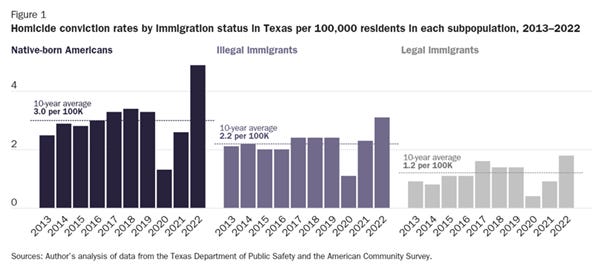
If the native-born American murder rate were as low as the illegal immigrant rate in Texas, there would have been about 1,861 fewer murders during the 2013-2022 period. If they murdered at the same low rate as legal immigrants, almost 2,750 fewer people would have been murdered in Texas.
The lower levels of illegal immigrant homicide convictions in Texas are no comfort to Jocelyn Nungaray or her family. Venezuelan illegal immigrants Johan Jose Martinez-Rangel and Franklin Jose Peña Ramos were charged with her murder in June 2024, and the evidence is overwhelming. As awful as her murder was at the probable hands of these vicious criminals, the illegal immigrant homicide conviction rate in the last year, for which there was reliable data, was 36 percent below that of native-born Americans.[xxix]
People aren’t surprised when you tell them that legal immigrants are much less likely to be criminals, but they are surprised when they find out that illegal immigrants have a lower criminal conviction rate because they remember the individual murders by illegal immigrants like Nungaray’s because they are reported in the news. What could explain that lower rate? Why would somebody willing to break immigration laws, where there are no victims, and take a chance on making a new life for themselves and their family in a foreign land away from the culture they grew up in be less likely to commit crimes? Put that way, the answer is obvious.
The types of people who emigrate are different from those who stay. They’re more ambitious, think more about the future, and take calculated risks—like paying a smuggler to enter the United States to work in the black market. But they don’t tend to take risks like committing murder or other crimes, which they could do in their home countries. Crime sometimes pays, but not on average.
One reason crime doesn’t pay for illegal immigrants is that their punishment is harsher than it is for American citizens. When Americans are convicted of a crime, they do their time and are released in the United States. When illegal immigrants are convicted of crimes, they are deported at the end of their prison sentence. This is the proper thing to do – criminals should be removed from the United States – but it’s also an extra punishment. Not only do you go to prison if you’re an immigrant convicted of a violent or property crime, but then you get deported back to poverty in the country you left – and maybe even to another prison if you’re from El Salvador. That’s a greater deterrent.
The government also tries to screen out criminals when they arrive, but it doesn’t always work. Peruvian Gianfranco Torres-Navarro arrived on the U.S.-Mexico border in May 2024. Border Patrol apprehended and released him after being given a court date to appear in front of an immigration court. Two months later, the Peruvian government informed the U.S. government that Torres-Navarro was wanted for the murders of 23 people in Peru because he was the head of the “Los Killer” gang. That gang’s name appears to literally describe their primary criminal activity.
Torres-Navarro’s nickname was “Gianfranco 23.” Shortly after learning that, ICE arrested Gianfranco 23 and held him for deportation back to Peru where he’ll be tried for homicide. He didn’t become Gianfranco 24 yet in the United States, and immigration enforcement performed well here once it had sufficient information to act, but we also can’t expect perfection. Law enforcement relies on information from domestic and international sources to function well. It worked out well in this case, but Torres-Navarro should never have entered in the first place.
Illegal immigrants have a good reason to follow criminal laws even if they broke immigration laws, with some probable exceptions like Gianfranco 23. But many criminals in the United States are recidivists – they commit one crime, are incarcerated, released, and commit another crime. They spend their lives going in and out of prison. However, illegal immigrants who are deported are less likely to be recidivists for the simple reason that few of them return to the United States after being removed, commit crimes, and get convicted again. They mostly stay put in their home countries. Maybe if all illegal immigrants were allowed to stay after serving their time, their crime rate would be higher than that of native-born Americans. Is that likely?
Probably not. The rate of illegal immigrants who are first-time offenders is more than one-third less than it is for native-born Americans – they really are less likely to commit crimes even when considering recidivism.[xxx] That means there’s less recidivism when those bad apples (bbaples?) are deported. But maybe illegal immigrants commit their crimes and flee back to their home countries or otherwise disappear before being caught. That seems plausible.
Plausible but unlikely. Police measure their effectiveness through many means, but a common one is the so-called clearance rate – which is just the percentage of reported crimes that have been resolved, or “cleared,” by an arrest, criminal charges being filed, or turning over a suspect for prosecution.[xxxi] The higher the clearance rate, the more effective the police are – at least in theory. If illegal immigrants commit many homicides or other crimes and then disappear or return to their home countries, there should be a lower clearance rate in places with many illegal immigrants. Turns out, there’s no difference between clearance rates for homicide or other crimes in states with many illegal immigrants and those with hardly any.[xxxii] Illegal immigrants aren’t criminal masterminds.
Americans Commit a Lot of Homicides
You’ve probably picked up on this by now, but Americans commit a lot of homicides – more than any other developed country. Our violence is the biggest reason why immigrants here seem so peaceful. In 2021, Germany had only 695 homicides and a rate of 0.8 per 100,000. In the US, there were 25,000 homicides in 2021, according to the Centers for Disease Control and Prevention – that’s a homicide rate of 8.2, or about ten times higher than in Germany. But Germany is not unter alles when it comes to homicide rates in developed countries. Singapore had seven homicides in 2021 and a rate of 0.1. American retirement homes may have a higher homicide rate than Singapore.
Our former au pair from Switzerland was astounded when she learned about American crime. In 2021, Switzerland had only 42 murders in a population of over 8.7 million for a rate of 0.42 per 100,000. In Washington, DC, the city closest to where we lived, there were 226 murders in 2021 out of a population of about 670,000 – a murder rate 70 times higher Switzerland’s.[xxxiii] You don’t have to be a former Attorney General to see that there is a lot of murder in the United States.
Homicide rates and homicide conviction rates aren’t the same. The former is the rate of actual homicides that occurred, and the latter is the rate of those who are convicted of homicide. They aren’t the same, but they’re related unless you think more homicides won’t eventually lead to more convictions. If illegal immigrants in Texas instead went to Germany, Singapore, or Switzerland and didn’t change their criminal behavior, they would have a homicide rate multiple times higher than the natives in those countries. Even relatively less homicidal legal immigrants would have a higher rate than the natives in both of those countries if they behaved the same. But it’s still worth repeating that native-born Americans would have the highest of all if they were transported to Europe and didn’t change their behavior.
It’s not an iron law of social science that immigrants must have a lower crime rate than natives – it depends on the immigrants, the natives, and other factors like the criminal justice system, economic opportunity, and how both change how people behave. There’s evidence that immigrants to European countries from outside of Europe have a higher crime rate than European natives.[xxxiv] This isn’t so surprising, as Europe has low crime and homicide rates compared to the United States. But in the cases where the data are available, and European crime data are even worse than American data, immigrants in Europe would have a lower homicide and crime rate than native-born Americans if they instead came to the U.S. The American incarceration rate for immigrants from the Middle East, the immigrants who most worry Europeans, is only 245 per 100,000 – about double what it is in Europe and one-sixth of the native-born American incarceration rate.[xxxv] Everything is bigger in America.
Other Crimes in Texas
Texas has the best crime data for legal and illegal immigrants, but the non-homicide data likely miscounts illegal and legal immigrant criminal convictions. Still, it’s worth showing their criminal conviction rates with that caveat. During the 10-year period of 2013–2022, the criminal conviction rate was 685 per 100,000 illegal immigrants, 551 for legal immigrants, and 1,321 for native-born Americans. In other words, illegal immigrants were 48 percent less likely than native-born Americans to be convicted of a crime, and legal immigrants were 58 percent less likely.[xxxvi] Who says America isn’t already great – at least with racking up criminal convictions?
Immigrants Aren’t Poisoning Americans with Opioids
Not long ago, I testified in front of Congress about immigrant criminality. Representative Tom Tiffany (R-WI) asked if my count of immigrant homicides included Americans who died of drug overdoses. “Of course not, drug overdoses aren’t homicides,” I replied. [xxxvii]The Republican members of Congress didn’t like that answer. Just goes to show you can’t trust a man whose surname is a woman’s first name.
What escaped the Congressmen is that murder victims and those who die from drug overdoses are different. Murder victims don’t want to be murdered; they are killed against their will, which is an extraordinarily odd thing to write because it is so unambiguously true despite what politicians say. On the other hand, drug users who overdose took a risk by consuming illegal and dangerous drugs and then suffered the consequences of their actions. It’s still a tragedy when a drug user overdoses, especially when he does so after consuming illegal drugs that are adulterated without his knowledge. Still, drugs are dangerous, and everybody knows that they take a risk when using harder drugs like heroin, fentanyl, or cocaine.
How dangerous are those drugs? The Centers for Disease Control and Prevention (CDC) estimates that almost 108,000 people overdosed in the United States in 2023, and 75 percent of them died while consuming opioids like heroin and fentanyl.[xxxviii] The synthetic opioid fentanyl is especially dangerous because it’s extremely potent – 50 to 100 times more potent than morphine – so fentanyl users are more likely to misjudge dose, the strength of fentanyl if it is illegally manufactured, or even be unaware that they are doing so.[xxxix] According to government surveys of drug use, about 8.9 million people misused opioids in 2023.[xl] You should take surveys that ask about illegal and deviant behavior committed by a socially disconnected subset of the population with a grain of salt bigger than Mount Everest, but they’re most likely marginally better than guessing.[xli] And I don’t like guessing.
Almost nine million people responded that they consumed opioids for a non-prescribed use in 2023, according to those surveys.[xlii] However, most of them reported illicitly consuming opioids in prescription drug form. About 828,000 of them, or less than 10 percent, reported using fentanyl.[xliii] The real number of users is probably multiple times higher, but the other wrinkle is that there’s a difference between the casual or occasional user of fentanyl and the addict. The medical jargon says a serious user of drugs suffers from Drug Use Disorder (DUD), which is close to what normal people commonly call an addict and who consume the drugs to severe, moderate, and mild extents.[xliv] About a fifth of all people with DUD are severe users, who are the most serious addicts.[xlv]
Assuming that a fifth of the fentanyl users and all those who overdosed are severe users, just less than half of them overdosed in 2023, which is an extreme way to look at the data. You can slice the data differently by changing the denominator. For instance, it could be that 10 percent of fentanyl users overdosed in 2023 if you divide the opioid overdoses by the 828,000 who reported using fentanyl or slightly less than 1 percent if you use the entire population that illicitly consumed opioids. The rate of overdose would be lower still if the surveys undercount drug use, which they certainly do.
The fact remains that consuming fentanyl is extremely dangerous no matter how you interpret the numbers. About 350,000 people a year skydive, and 10 lost their lives jumping out of an airplane in 2023, for a death rate of about 2.9 per 100,000.[xlvi] The most conservative estimate of the overdose death rate for fentanyl users above for the same year is about 979 per 100,000. Using fentanyl is about 343 times as dangerous as jumping out of an airplane. It’s a safer way to get high and then low than fentanyl. This is only one way to present the risks and hazards of drug use, and it ignores the other medical problems, lost dreams, ruined ambitions, and pain caused by using drugs or jumping out of airplanes, but it is the easiest and most useful to understand. Using fentanyl is one of the most dangerous activities an American can undertake, but it’s not homicide.
Trump blamed American deaths from drug use on illegal immigration when he said:
[C]ontained within this giant flow of illegal migration to our southwest border is the movement of illicit and deadly narcotics. It’s in the southwest, most of it comes in. Nearly 100 percent of heroin in the United States enters through the southern border– think of that: 100 percent, almost, of heroin comes in through the southern border, along with roughly 90 percent of cocaine, and the majority of meth, and a substantial portion of the ultra-lethal fentanyl killing our youth. Fentanyl is killing our youth.[xlvii]
Unlike murder, illegal drug use has a supply and demand component, where the drug users themselves want the drugs. This is unlike murder, where nobody wants to be murdered. Drug users pay extraordinary prices to engage in a risky activity that they enjoy. Some murder victims are criminals who engage in risky criminal activity that they know increases their chance of being murdered, but their behavior is fundamentally less risky than consuming drugs with a high chance of poisoning themselves. The demand side of drug use is driven by American consumers.
But what about the supply? People can demand all the drugs that they want, but they can’t use them if there’s no supply. On the flip side, a massive supply would lower drug prices, but fewer people would use them in such a world if they didn’t demand them. But who is smuggling in the supply of drugs? It’s difficult to study drug black markets because they are illegal. However, data from Customs and Border Protection (CBP) provides some clues. From 2019 to 2024, 92 percent of drugs CBP seized near the border were at a port of entry or an interior checkpoint – illegal immigrants did not smuggle them in their backpacks when crossing the desert.[xlviii] More than four out of five of those arrested for smuggling fentanyl were US citizens.[xlix]
That means immigrants and non-citizens were slightly overrepresented among drug smugglers, but not by much, and certainly much less than claimed by Trump. Above and beyond that, the numbers don’t compare the quantity smuggled, and US citizens probably stand out even more. The largest CBP bust of fentanyl netted 234 packages of drugs that contained 4 million blue fentanyl pills in July 2024.[l] The smuggler was a 20-year-old American citizen from Arizona who attempted to drive them into the United States through a legal port of entry. “This is an enormous amount of dangerous drugs that officers at the Port of Lukeville prevented from reaching communities throughout the United States,” said Guadalupe Ramirez, Director of Field Operations for CBP, upon the announcement of the arrest.[li] In that year, the number of overdose deaths dropped by over a quarter. The rate of overdoses started to recede as the illegal immigrant population peaked during the last year of the Biden administration.[lii]
American citizens are the primary drug smugglers along the border by arrests and convictions, but that probably understates their share of the total quantities of drugs smuggled. After all, it’s easier to smuggle larger quantities across the border through legal ports of entry with an American passport than pull them through a tunnel or hike them through the desert. That requires US citizens to actually be the smugglers to maximize their chances of entering legally and undetected. Drug users are responsible for their own behavior, and drug suppliers meet their demand. Still, immigrants are not the primary smugglers – they aren’t trying to poison you with fentanyl.
Illegal Immigrants Aren’t Coming to Kill You
At least in Texas, they’re not, especially when compared to native-born Americans. If your city had a homicide conviction rate of 10 per 100,000 and a population of one million, what would happen to the homicide rate if 100,000 illegal immigrants with the Texan rate of homicide conviction moved in? The homicide conviction rate would drop to 9.3. If another 100,000 legal immigrants moved in, the homicide conviction rate would fall further to 8.6. The number of homicides would rise in both cases, but the population would rise even more. Does Texas tell us anything about the United States as a whole? Probably, if the nationwide incarceration numbers are to be believed. You already have a better grasp of how crime can make your life more dangerous than the former undocumented head of an immigration agency who was also the attorney general of Virginia.
As mentioned above, Texas is a great state to study. Other states should follow Texas’s lead on keeping illegal and legal immigrant criminal conviction data, in addition to copying the state’s income tax laws, fine cuisine, and affordable cities. Perhaps other states do have different outcomes and illegal or legal immigrants commit more homicides than natives there, but probably not. The state-level factor that could change the calculus is if a state has weak criminal enforcement, poor policing, and just lets criminals run wild. In such a case, more illegal immigrants would become criminals, but so would native-born Americans – so it could even be a wash. But I don’t want to take the risk.
Furthermore, lower illegal immigrant and legal immigrant incarceration rates nationwide indicate that they are less likely to be criminals than native-born Americans. Their lower level of criminality can be explained by several factors. The first is self-selection. Immigrants who want to start a new life are less likely to want to commit crimes that could jeopardize their chances of achieving the American dream. Another is that the federal government also attempts to screen out criminals from coming here, which dissuades some from trying in the first place and deports those who become criminals before they can reoffend or even before their first attempt here. And the biggest and most underdiscussed reason is that huge portions of humanity are less violent and criminally inclined than Americans, so they just can’t help looking good. Immigrants are not coming to murder you, but a native-born American just might.
[i] “How the Border Crisis Impacts Public Safety,” United States House Committee on Oversight and Accountability, April 16, 2024; Hearing on How the Border Crisis Impacts Public Safety, Before the Committee on Oversight and Government Reform, Subcommittee on National Security, the Border, and Foreign Affairs, 118th Cong. 1st Sess. (April 16, 2024) (statement of Hon. Ken Cuccinelli, Senior Fellow for Immigration and Homeland Security, Center for Renewing America).
[ii] Eric Lichtblau and Monica Davey, “Homicide Rates Jump in Many Major U.S. Cities, New Data Shows,” The New York Times, May 13, 2016.
[iii] Jacqueline Howard, “US records highest increase in nation’s homicide rate in modern history, CDC says,” CNN, October 6, 2021.
[iv] Cybele Mayes-Osterman, “Homicide rates dropped in big cities. Why has the nation’s capital seen a troubling rise?,” USA Today, January 22, 2024.
[v] Meredith Deliso, “Grand jury indicts Laken Riley murder suspect on 10 counts,” ABC News, May 8, 2024.
[vi] James Doubek, “Judge Says Ken Cuccinelli Was Appointed Unlawfully to Top Immigration Post,” NPR, March 2, 2020.
[vii] “How the Border Crisis Impacts Public Safety,” United States House Committee on Oversight and Accountability, April 16, 2024; Hearing on How the Border Crisis Impacts Public Safety, Before the Committee on Oversight and Government Reform, Subcommittee on National Security, the Border, and Foreign Affairs, 118th Cong. 1st Sess. (April 16, 2024) (statement of Hon. Ken Cuccinelli, Senior Fellow for Immigration and Homeland Security, Center for Renewing America).
[viii] Sasha Ingber and Rachel Martin, “Immigration Chief: ‘Give Me Your Tired, Your Poor Who Can Stand on Their Own 2 Feet’,” NPR, August 13, 2019.
[ix] Lee DeVito, “Detroit and the word ‘motherfucker’: a brief history,” Detroit Metro Times, March 26, 2024.
[x] Edward L. Glaeser and Andrei Shleifer, “The Curley Effect: The Economics of Shaping the Electorate,” Journal of Law, Economics, and Organization 21, no. 1 (April 1, 2005): 1–19.
[xi] Alex Nowrasteh, “Crime Rates, Not the Number of Crimes, Are a Better Way to Judge Immigrant Criminality,” Cato at Liberty (blog), April 17, 2024.
[xii] George Hunter, “Detroit on pace for fewest homicides since 1966; officials credit this program,” The Detroit News, December 4, 2023.
[xiii] John Maynard Keynes, A Tract on Monetary Reform (The Richest Man in Babylon, 2009).
[xiv] Alex Nowrasteh, “Illegal Immigrant Murderers in Texas, 2013–2022,” Cato Institute Policy Analysis no. 977, June 26, 2024.
[xv] Adam B. Lerner, “Ann Coulter: Immigrants are worse than ISIL,” Politico, May 26, 2015.
[xvi] Katherine Santana, “Ann Coulter Says Americans Should Fear Immigrants More Than ISIS,” Cosmopolitan, May 27, 2015.
[xvii] “United States hog inventory up 1%,” National Agricultural Statistics Service, US Department of Agriculture, March 28, 2024; “FCC License Counts,” The American Radio Relay League, The National Association for Amateur Radio, accessed August 14, 2024; Ann H. Coulter, ¡Adios, America!: The Left’s Plan to Turn Our Country into a Third World Hellhole (Washington, DC: Regnery Publishing, a division of Salem Media Group, 2016), pp.100-103.
[xviii] “Quick facts on Non-U.S. Citizen Federal Offenders” FY 2017 through FY 2021 Datafiles, United States Sentencing Commission.
[xix] “Quick facts on Non-U.S. Citizen Federal Offenders” FY 2017 through FY 2021 Datafiles, United States Sentencing Commission; “Offenses,” Federal Bureau of Prisons, accessed August 13, 2025.
[xx] Charles R. Breyer et al., “2021 Annual Report and Sourcebook of Federal Sentencing Statistics,” United States Sentencing Commission, table 9.
[xxi] E. Ann Carson, “Prisoners in 2021 – Statistical Tables,” Bureau of Justice Statistics, United States Department of Justice, December 20, 2022;
[xxii] Alex Nowrasteh, “Immigration and Crime – What the Research Says,” Cato at Liberty (blog), July 14, 2015; Alex Nowrasteh, “Illegal Immigrants and Crime – Assessing the Evidence,” Cato at Liberty (blog), March 4, 2019.
[xxiii] Michelangelo Landgrave and Alex Nowrasteh, “Illegal Immigrant Incarceration Rates, 2010–2023,” Cato Institute Policy Analysis no. 994, April 24, 2025.
[xxiv] Alex Nowrasteh, “Immigrants Have a Lower Incarceration Rate than Native-Born Americans, Even When Excluding Black Americans,” Cato at Liberty (blog), April 25, 2025.
[xxv] Alex Nowrasteh, “Illegal Immigrants Have a Low Homicide Conviction Rate: Setting the Record Straight on Illegal Immigrant Crime,” Cato at Liberty (blog), February 28, 2024; Glenn Kessler, “The Truth About Illegal Immigrant and Crime,” The Washington Post, February 29, 2024.
[xxvi] Alex Nowrasteh, “Illegal Immigrants Have a Low Homicide Conviction Rate: Setting the Record Straight on Illegal Immigrant Crime,” Cato at Liberty (blog), February 28, 2024.
[xxvii] Alex Nowrasteh, “Illegal Immigrant Murderers in Texas, 2013–2022,” Cato Institute Policy Analysis no. 977, June 26, 2024.
[xxviii] Alex Nowrasteh, “Laken Riley’s death made the news, but here’s the real story on undocumented migrants,” USA Today, March 19, 2024.
[xxix] Alex Nowrasteh, “Police Clearance Rates Are Not Lower in States with Many Illegal Immigrants,” Cato at Liberty (blog), October 23, 2018.
[xxx] Alex Nowrasteh and Andrew C. Forrester, “Illegal Immigrant Conviction Rates Are Low, Even When Factoring in Recidivism,” Cato at Liberty (blog), January 7, 2019.
[xxxi] “Homicide Closure Rates,” Metropolitan Police Department of the District of Columbia, accessed August 15, 2024.
[xxxii] Alex Nowrasteh, “Police Clearance Rates Are Not Lower in States with Many Illegal Immigrants,” Cato at Liberty (blog), October 23, 2018.
[xxxiii] “Homicide Closure Rates,” Metropolitan Police Department of the District of Columbia, accessed August 15, 2024.
[xxxiv] Emil O. W. Kirkegaard, “New Paper out: Public Preferences and Reality: Crime Rates among 70 Immigrant Groups in the Netherlands,” Clear Language, Clear Mind (blog), February 16, 2020; Robert Semonsen, “BKA Report: Sharp Uptick in Violent Crime Committed by Migrants against Germans,” The European Conservative, November 16, 2023.
[xxxv] Michelangelo Landgrave and Alex Nowrasteh, “Illegal Immigrant Incarceration Rates, 2010–2018,” Cato Institute Policy Analysis no. 890, April 21, 2020, table 2 under “Illegal Immigrant Incarceration Rates over Time”; “Prison Statistics,” Statistics Explained, Eurostat, April 2024, under “Highlights.”
[xxxvi] Alex Nowrasteh, “Illegal Immigrant Murderers in Texas, 2013–2022,” Cato Institute Policy Analysis no. 977, June 26, 2024.
[xxxvii] Alex Nowrasteh, “How to Make Congress Yell at You,” Laissez-Faire, Laissez-Passer w/ Alex Nowrasteh and David Bier (blog), June 26, 2025.
[xxxviii] Centers for Disease Control and Prevention, “U.S. Overdose Deaths Decrease in 2023, First Time Since 2018,” CDC, May 15, 2024.
[xxxix] Substance Abuse and Mental Health Services Administration, Key Substance Use and Mental Health Indicators in the United States: Results from the 2023 National Survey on Drug Use and Health, (HHS Publication No. PEP24-07-021, NSDUH Series H-59), Center for Behavioral Health Statistics and Quality, Substance Abuse and Mental Health Services Administration, 2024, p. 21.
[xl] Substance Abuse and Mental Health Services Administration, Key Substance Use and Mental Health Indicators in the United States: Results from the 2023 National Survey on Drug Use and Health, (HHS Publication No. PEP24-07-021, NSDUH Series H-59), Center for Behavioral Health Statistics and Quality, Substance Abuse and Mental Health Services Administration, 2024, p. 20.
[xli] Birguslatro, “Survey Chicken,” Carcinisation (blog), December 11, 2020.
[xlii] Substance Abuse and Mental Health Services Administration, Key Substance Use and Mental Health Indicators in the United States: Results from the 2023 National Survey on Drug Use and Health, (HHS Publication No. PEP24-07-021, NSDUH Series H-59), Center for Behavioral Health Statistics and Quality, Substance Abuse and Mental Health Services Administration, 2024, p. 20.
[xliii] Substance Abuse and Mental Health Services Administration, Key Substance Use and Mental Health Indicators in the United States: Results from the 2023 National Survey on Drug Use and Health, (HHS Publication No. PEP24-07-021, NSDUH Series H-59), Center for Behavioral Health Statistics and Quality, Substance Abuse and Mental Health Services Administration, 2024, p. 21.
[xliv] Substance Abuse and Mental Health Services Administration, Key Substance Use and Mental Health Indicators in the United States: Results from the 2023 National Survey on Drug Use and Health, (HHS Publication No. PEP24-07-021, NSDUH Series H-59), Center for Behavioral Health Statistics and Quality, Substance Abuse and Mental Health Services Administration, 2024, pp. 24-31.
[xlv] Substance Abuse and Mental Health Services Administration, Key Substance Use and Mental Health Indicators in the United States: Results from the 2023 National Survey on Drug Use and Health, (HHS Publication No. PEP24-07-021, NSDUH Series H-59), Center for Behavioral Health Statistics and Quality, Substance Abuse and Mental Health Services Administration, 2024, p. 30.
[xlvi] “Number of Skydiving Fatalities in the United States from 2000 to 2023,” Statista, June 13, 2024; “Safety & Our Staff,” Skydive Zion.
[xlvii] “Remarks by President Trump on the Illegal Immigration Crisis and Border Security,” The White House Archives, National Archives and Records Administration, November 1, 2018.
[xlviii] David J. Bier, “US Citizens Were 80.2 Percent of Crossers with Fentanyl at Ports of Entry from 2019 to 2024,” Cato at Liberty (blog), August 8, 2024.
[xlix] David J. Bier, “US Citizens Were 80.2 Percent of Crossers with Fentanyl at Ports of Entry from 2019 to 2024,” Cato at Liberty (blog), August 8, 2024.
[l] “CBP Officers in Arizona Seize More than Half a Ton of Fentanyl in Largest Seizure in Agency History,” Customs and Border Protection, August 1, 2024.
[li] “CBP Officers in Arizona Seize More than Half a Ton of Fentanyl in Largest Seizure in Agency History,” Customs and Border Protection, August 1, 2024.
[lii] “U.S. Overdose Deaths Decrease Almost 27% in 2024,” CDC National Center for Health Statistics, May 14, 2025.