

Read Part I, Part II, Part III, Part IV, Part V, Part VI, Part VII, Part IX, and Part X of What People Really Care About When They're Mad About Immigration.
“It’s [espionage] R&D on cocaine. Maybe you can have a little bit of fun with it, but it’s not good for you in the long run.”
– Erik Meyersson on industrial espionage[1]
“If you’re looking everywhere for spies, you will find spies everywhere, even where they don’t exist.”
– Mark Rasch, former computer-crime prosecutor[2]
The United States is locked in a struggle with Communist China for global economic and political dominance. Chinese spies are attempting to steal the most valuable national military and economic secrets so they can outgun and outgrow the United States. The Department of Justice answered with the China Initiative, an investigative blitz to root out the nefarious Chinese spies seeking to undermine American sovereignty.[3] The China Initiative had many victories, like the prosecution and conviction of Chinese immigrant Xiaorong You.[4] She had access to vital secrets that she stole from a giant American chemical company and sent to China to enrich herself and glorify the Chinese Communist Party.
The brave prosecutors at the China Initiative eventually caught up with You after she had caused much damage to the homeland. A jury convicted her of wire fraud, conspiracy to steal trade secrets, theft of trade secrets, and economic espionage of vital national security and economic secrets. What were the secrets she stole? Formulations for bisphenol-A-free coatings that are used on the inside of Coca-Cola cans to better preserve flavor.[5] It is only a slight exaggeration to say that making sure Chinese firms can’t preserve soda as well as Coca-Cola provides the margin that would win a war and preserve American sovereignty. We could not, and the US government ultimately did not allow a Coke-quality gap.
The previous paragraphs are my best attempt to make a big deal out of a minor espionage case unrelated to national security that the government nevertheless justified on national security grounds. What’s next? Will the Chinese steal the magical incantations that make Diet Mountain Dew the best soda? You (You, not you) committed a crime; she stole valuable secrets that cost nearly $120,000,000 for Dow Chemical, Sherwin-Williams, DASF, and others to develop. She is a criminal who violated the property rights of American corporations. Her actions slightly reduced the incentive to innovate, and she deserved punishment.[6] Still, You’s case is not an example of Chinese espionage undermining US national security as the China Initiative and others claimed.
Most popular ideas about espionage and spies come from mediocre fiction like the nearly unwatchable James Bond movies and the fanciful novels by Tom Clancy. More nuanced spy fiction like the works of David John Moore Cornwell, better known by his pen name John le Carré, are well-read, but they haven’t affected our cultural view of spies. We view spies as dashing, suave, and vicious like James Bond, not the depressive, plodding, and intelligent bureaucrats like George Smiley, whose main weapon is his brain, a pen, and a telephone. Espionage can pose a serious threat, and spies sometimes steal important military, technological, or economic secrets that could undermine American security. However, those types of espionage are the exceptions that prove the rule because immigrants are not coming to steal our secrets, and the secrets they do steal are mostly not related to US national security.
There are some immigrant spies, just like there are some immigrants who are murderers, criminals, mass shooters, and terrorists. But unlike those other crimes, espionage is not as well-known. Law enforcement won’t know about espionage if it fully and successfully achieves its goals, while the entire point of terrorism is to scare people with public acts of violence to prompt political change, and it’s hard for murderers to hide bodies. We fear what we can’t see, so espionage frightens us more than it should. Our fear of espionage is greater than the actual threat because so much of it happens in the darkness. Or so people think.
Americans are fearful of espionage from countries like China. Still, we know more about Chinese espionage because the government has focused so many resources on rooting it out, which may make it seem riskier than it is. A thorough accounting of the publicly known cases of espionage shows that there are some serious cases where the secrets stolen could threaten American national security, many cases that impose some economic harm but do no damage to national security, and others that show the Chinese intelligence services aren’t sending their best. Chinese spies aren’t sending their equivalents of Sean Connery. Heck, they’re not even sending their own Roger Moore.
The Legitimate and Exaggerated Fears of Chinese Espionage
Communist China is America’s primary geopolitical adversary. After the fall of the Soviet Union, the United States was the world’s sole superpower, while China was recovering from decades of Maoist rule as its leadership embraced some market reforms beginning in the late 1970s. Maoist economic policy was so deadly and destructive that the catch-up growth, which happens when a poor country grows more quickly and catches up to richer countries, was phenomenal according to government statistics. The Chinese economy made up for lost decades by growing by an average of about 10 percent per year during the 1990s, or about 160 percent total from 1990 to 2000.[7] Even if the Chinese government’s statistics weren’t accurate then, and there’s good reason to think that they exaggerated the prosperity, nobody could doubt that the economy was growing tremendously.
China’s increased prosperity worried American policymakers because Communism was America’s great ideological foe for so much of the 20th century, and a richer country can be a greater military threat. A wealthy communist country was a different threat that the US had never faced, aside from hyperbolic predictions of Soviet economic growth that never materialized.[8] China was less communist than before, which is why the economy was growing in the first place, and less aggressive except toward the Taiwanese. Former de facto premier Deng Xiaoping made such anti-Marxist statements as, “To get rich is glorious.” However, the government still clung tenaciously to the communist one-party state ideology as they saw what happened to Soviet and other Eastern European communist party leaders. Nobody in the Chinese government wanted to end up like Nicolae Ceaușescu and his wife, who were rightly executed on Christmas Day, 1989, for heading the brutal Romanian communist dictatorship.
The ideological disagreements allowed disagreements between the two countries to rise rapidly in response to minor provocations. Tensions between the United States and China rose somewhat on April 1st, 2001, when a Chinese jet collided with an American spy plane in midair over a disputed area in the South China Sea, killing the Chinese pilot and forcing the American plane to make an emergency landing on the Chinese island of Hainan. The Chinese held the crew until April 11th, after the US sent the so-called “letter of the two sorries,” which was a non-apology apology for the death of the Chinese pilot and for entering Chinese airspace.
Diplomats on both sides calmed the situation, but there was a real sense that US-Chinese tensions had permanently heightened. Then the 9/11 attacks intervened, and the United States spent two decades spilling blood, spending treasure, and wasting prestige on Middle Eastern quagmires. China also changed when America was losing wars in the Middle East. Chinese Secretary of the Communist Party Hu Jintao retired in 2012 and was replaced by Xi Jinping, who adopted a “wolf warrior diplomacy” strategy that was more aggressive, nationalistic, and stylish, as a popular Chinese movie inspired it. The Chinese government focused on Taiwan and other territorial disputes in the South China Sea.
Donald Trump took office as President in 2017 with a foreign policy message that combined military fears of a growing China with his general economic concerns about China “taking” American manufacturing jobs. The idea that countries steal jobs is childish, but doubly so as the number of manufacturing jobs in China peaked around 2010 after fits and starts and has since fallen.[9] Even so, if firms in one country can do your job better and cheaper, you should find a new way to make money. Not known for prizing efficiency, the Trump administration slapped numerous tariffs on Chinese imports, and the Chinese retaliated, raising prices for American and Chinese consumers.[10]
Fear of Chinese espionage also rose as 77 cases of discovered Chinese spies were made known from 2013 to the end of 2017. Of those cases, 42 attempted to steal information or technology directly owned by the US government. Half of those spies were born in China. The case of Su Bin is typical. He ran a China-based aviation and aerospace company from Canada and traveled to the U.S., where he conspired with others and military hackers from China to steal data on the F-22 and F-35 fighter jets and Boeing’s C-17 military transport.[11] Su was arrested and sentenced to four years in prison. Some of them weren’t good people.
However, 14 of the Chinese spies were white native-born Americans with a smattering of others from India, Pakistan, Taiwan, and Ghana. Kevin Patrick Mallory was a former CIA case officer who also worked for the Defense Intelligence Agency and several defense contractors over a long career. He left the government in 2012 and had some personal financial troubles. That’s when the Chinese Ministry of State Security contacted him while pretending to be a headhunter for the Shanghai Academy of Social Sciences. After two visits to China, Mallory began selling secrets to the Chinese government in 2017. Mallory intended to transmit more documents to Chinese intelligence and to revisit China by the time he was arrested in mid-2017. He was convicted and sentenced to 20 years in prison for numerous espionage and related crimes. Most seriously, he gave the Chinese government unique identifiers of people who had helped the US government in China, among other classified information.[12]
The US government wasn’t the only victim of Chinese espionage. Thirty-five Chinese spies targeted numerous American firms and one university for their valuable trade secrets and intellectual property. Of those, 26 were born in China. Mo “Robert” Hailong was sentenced to prison for three years for conspiracy to steal inbred corn seeds, which were valuable trade secrets of DuPont Pioneer and Monsanto.[13] Hailong was the Director of International Business of the Beijing Dabeinong Technology Group, a company with a corn seed subsidiary. He had purchased several fields in Iowa and Illinois that he used as a base to steal seeds physically from nearby test fields owned by DuPont Pioneer and Monsanto. Security agents at the fields noticed trespassing and alerted the FBI, which investigated, leading to Hailong’s arrest and conviction.[14] Hailong harvested a 36-month prison sentence for conspiracy to steal trade secrets.
Federal prosecutors charged native-born Americans Robert Ewald and Donald Olgado with conspiring with Chinese-born Liang Chen and Wei-Yung Hsu to steal technology from a Bay Area semiconductor firm to set up their own competing firm in the United States and China in 2017.[15] They allegedly stole information on fully automated high-volume clean room manufacturing techniques for semiconductor wafers used in electronics that were developed at enormous cost. The spies weren’t careful as they shared their plans in an email about how to start a new firm in China and the United States with the new technology. The jury acquitted Ewald, Chen, and Hsu but convicted Olgado of 11 counts of possession of stolen trade secrets.[16] The Chinese weren’t even sending spies in this case.
The abovementioned espionage cases prompted President Trump’s Department of Justice to create the China Initiative in 2018 to detect, prosecute, and stop Chinese economic espionage.[17] In 2020, Attorney General William Barr said,
The People’s Republic of China is now engaged in an economic blitzkrieg – an aggressive, orchestrated, whole-of-government (indeed, whole-of-society) campaign to seize the commanding heights of the global economy and to surpass the United States as the world’s preeminent technological superpower.[18]
Chinese espionage during the Cold War was different from Soviet espionage. The Soviets were mostly geared toward stealing American military secrets, though there was a substantial economic espionage component as well.[19] The US government was already adept at discovering and dissuading spies who focused on stealing government secrets and classified information under the Espionage Act of 1917 and didn’t need a new initiative to crack down on Chinese spies trying to infiltrate the government. However, the US government was relatively unprepared for economic espionage and the state theft of private information. Economic espionage wasn’t even a federal crime until 1996. A combination of the Trump administration’s protectionist economic policies, concerns over China’s more aggressive foreign policy, and some egregious cases of Chinese espionage prompted the Department of Justice to create the China Initiative.[20]
The US government had good reasons for being relatively unconcerned about economic espionage. On a gut level, it is hard to get as worried about economic espionage as, say, a spy attempting to steal American weapons programs – especially when laws protecting firm economic secrets were only passed during the Clinton administration. Economic espionage imposes a cost on American firms and investors who have spent money on research and development, but the DOJ claims that the Chinese government is stealing economic secrets to become wealthier than the United States. That doesn’t pass a smell test. Economic espionage is as likely to help the Chinese economy outperform the United States as smoking methamphetamine is to help you join the NBA.
Governments with serious economic and institutional defects often think they can rely on state-sponsored economic espionage to overcome them and innovate. The basket case economies of the Soviet Union and Soviet satellite states tried this by sponsoring economic espionage against the West to narrow the technological and economic gap during the Cold War.[21] That espionage had some notable successes, especially in the economic and social basket case of East Germany. I don’t always compliment communists, but when I do, it’s usually because a surface achievement hides an underlying fatal flaw.
Economists Albrecht Glitz and Erik Meyersson uncovered just such a flaw. They used information from East Germany’s foreign intelligence services to investigate that country’s economic returns to economic espionage over the last 20 years of the Cold War. They linked information from East Germany’s spies to the sectors of the West German economy that were spied on. The economists found that the productivity gap between West and East Germany would have been 13.3 percent wider without economic espionage.[22] The return on East German economic espionage was very high, at around €4.6 billion in 1988, compared with annual spying expenditures of about €6.4 million.[23] That’s a measly 72,000 percent return, which is so high that it would make Palantir and other firms constructing our police state blush. Maybe smoking meth can help you excel in professional sports?
Not so fast. The value of those secrets was substantial but came from just a handful of high-quality pieces of economically valuable information in large East German economic sectors that were already closer to the frontiers of West German technology.[24] The worst effect of the economic espionage on East Germans was that it reduced investment in research and development in East Germany. “Why invest money in making discoveries better suited to your own economy when you can just steal them?” is a reasonable question until the pace of scientific and technological discoveries slows and the stolen economic secrets are less valuable. Economic espionage is a way for your economy to keep up for a while, but eventually, West Germany innovated away from the East, and the stolen secrets weren’t as valuable. As West Germany developed more technology, the value of secrets stolen by the East Germans fell. After all, what is the use of West German software used to manage state-of-the-art assembly lines when East Germany didn’t even have the right types of computers, capital goods, or trained technicians to operate them in the first place?
Technologically sophisticated secrets just aren’t that valuable for more primitive societies. One of the more successful East German spies commented to his case officer, “I’m giving you the best technology available, why can’t you use it?”[25] The East Germans were playing sports while high, which just made them miss more baskets while feeling good about it. Meyersson said that commercial espionage is, “R&D on cocaine. . . Maybe you can have a little bit of fun with it, but it’s not good for you in the long run.” Economic espionage is not the way to become a world leader in anything. The East Germans were sending their best spies but should have sent their best minds to the R&D lab instead.
The Chinese government’s theft of classified information could reduce America’s national security, but economic espionage is less worrying. Chinese economic espionage imposes real costs on American firms, but it’s a sign of Chinese weakness that points to serious institutional problems in the Middle Kingdom. The Biden administration ended the China Initiative in February 2022, but prosecutions of Chinese spies continue, as it was folded into a broader strategy to go after spies from all countries.
How Many Spies Are There?
Nobody asks this question because it’s impossible to answer. Spies don’t want to be caught; they try to hide their crimes, and it’s very difficult to notice stolen information when it’s copied. By comparison, terrorists are easy to find. They often want to get caught or die in their attacks, they don’t want to hide their crimes, and they try to make sure the world knows about them. Murderers don’t want to get caught, and they mostly try to hide their crimes, but it’s difficult to hide a body and easy to notice when somebody is missing. However, the US government has caught several spies over the decades, so we know something about them. We don’t know about all the spies in the way we know almost all the terrorists, but espionage isn’t a total mystery either.
There were 670 or so spies caught conducting espionage on US soil from 1990 to the end of 2019. This doesn’t include those convicted of violating the Arms Export Control Act (AECA) because most of them aren’t spies but criminals caught selling weapons to other criminals overseas. Some violators of the AECA are spies, like Kan Chen, who was convicted of illegally exporting night vision equipment to China, or Mozaffar Khazee, who attempted to export proprietary military jet engine equipment to Iran, but they are the exceptions. The following numbers will focus on those who are undoubtedly spies.
About 56 percent of spies were born in other countries and were either immigrants or visiting here. The annual chance of a foreign-born person being a spy who was caught was about 1 in 5.3 million per year, which is even less than being a foreign-born terrorist. Native-born Americans were the largest group by country of origin and accounted for almost half of all spies. Chinese spies were the largest group after Americans, accounting for under a fifth.
Sixty percent of all the spies stole or tried to steal economic secrets, and the rest targeted classified US government information. The proportions are nearly identical for spies who spied for China.
Naval nuclear engineer Jonathan Toebbe and his wife, Diana, were sentenced to decades in prison in 2022 for attempting to sell secret information to the Brazilian government.[26] The Brazilian government notified the United States, and the two cooperated to gather information for a successful arrest and prosecution of the Toebbes. Why they decided to sell information to Brazil, a close US partner in intelligence and defense policy, isn’t explained in news stories or press releases about the case.[27] Jonathan concealed an SD card full of sensitive information inside of a peanut butter sandwich that he passed on to an undercover agent for $10,000 in cryptocurrency. Jonathan’s nutty operation didn’t go smoothly, and he found himself charged with conspiracy to communicate restricted data, ruining his life in a jiffy.
A less sticky spy case involved Dongfeng “Greg” Chung, a Chinese immigrant and former Boeing employee who was the first person convicted by trial under the Economic Espionage Act of 1996.[28] He stole several secrets related to Space Shuttle technology and potentially other defense, government, and commercial projects that he then sold to China. There was considerable disagreement in the trial about whether Chung stole publicly available and valuable information, prompting the judge to detail how.[29] While some of the information was probably worthless, some was undoubtedly valuable, and Chung was likely rightly convicted of economic espionage. Some of them, I assume, could be good spies.
Chasing Rumors, Ending Futures, and Exaggerating Dangers
Too much focus on Chinese spies may exaggerate their numbers and influence. Imagine you’re trying to find needles in a very large haystack. The haystack is so large that it runs from your barn, into the fields, through the pig pen, around the chicken coop, and into the kitchen of your house. But you want to find the needles that you think will do you the most harm, so you only search the hay in your kitchen. Lo and behold, you find needles in the hay in your kitchen and declare, “There are more needles in my kitchen than anywhere else in this haystack.” That could be true, but you don’t know that for sure because you only searched the hay in your kitchen. A thorough search of the rest of the hay may turn up more needles in the barn or chicken coop, but you don’t know because you didn’t look there. The China Initiative turned up more Chinese spies because they looked for Chinese spies. An India Initiative or Russia Initiative would have uncovered many more spies from those countries.
But it gets even more confusing when you can’t distinguish between a needle and a piece of straw. Law enforcement and prosecutors frequently confuse innocent people with spies. Former computer crime prosecutor Mark Rasch spoke about the case of Sherry Chen when he said, “If you’re looking everywhere for spies, you will find spies everywhere, even where they don’t exist.”[30] Chen worked at the National Weather Service in Wilmington, Ohio. The government accused her of using a stolen password to download information about dams and lying about meeting a high-ranking Chinese official when she last visited her country of birth. They arrested her on four federal charges that could carry a maximum penalty of 25 years in prison and a $1 million fine. The government dropped the charges five months later without explanation.
Xiaoxing Xi was another victim of wrongful prosecution. In May 2015, the FBI arrested Xi, a physicist at Temple University, for sharing information on pocket heater technology used in superconductivity research with China. However, the government dropped the charges when prosecutors learned that the research Xi shared with Chinese coauthors was on topics unrelated to the pocket heater or other sensitive technology.[31] Prosecutors who look for spies sometimes find too many.
Prosecutors often also look in the wrong places. It’s true that there are spies for China in the United States, but immigrants from China and Americans of Chinese descent are the only Asian American group by country of origin that has a net-negative view of where their ancestors came from.[32] There’s no group of Americans who have favorable net views of China. The one consistent positive effect of communist governments is that they convince people to hate them.
Part of the worry over espionage comes from the actions and statements of the Chinese government that appear to subsidize espionage. The Chinese communist party has ambitious economic plans to modernize and develop science and technology domestically in collaboration with foreign researchers, and they’re not scrupulous about avoiding espionage. The Chinese government’s Made in China 2025 initiative aims for certain sectors of the economy to be less reliant on imports and to be a world leader in science and technology by 2050. Their main ways of trying to achieve this goal are the 200 talent‐recruitment plans relying on government-funded Confucius Institutes that try to propagandize China’s glories at foreign universities, the so-called Thousand Talents Program that pays researchers to move to China, and large subsidies for research.[33] The Confucius Institutes mostly shut down, rebranded, or changed their activities in response to some of the legitimate concerns about being nodes of underhanded activity. There is more than a hint of economic espionage in all these endeavors, especially in trying to encourage international partnerships between Chinese and American researchers.
Physics professor James Patrick Lewis at West Virginia University was sentenced to three months’ incarceration and fines for participating in the Thousand Talents Program.[34] Specifically, Lewis asked West Virginia University for an alternative parental work arrangement without telling administrators that he would be traveling to a Chinese university to satisfy his work obligations under the Thousand Talents Program. He was researching unclassified coal conversion technology, and there is no evidence that he sought to share secrets with his Chinese counterparts. In the end, the government converted Lewis’s fraudulent workplace leave claim into an espionage-related conviction.
Lewis wasn’t the only one targeted in this dubious way. Chinese-born rheumatology professor Song Guo Zheng pled guilty to lying on National Institutes of Health grant applications seeking to hide his participation in the Thousand Talents program.[35] He was sentenced to 37 months. Chinese-born neuroscience professor Xiao-Jiang Li at Emory University was convicted of filing a false tax return for not disclosing compensation from Chinese universities as part of the Thousand Talents program.[36] A major focus of his research was using large animal models to investigate Huntington’s disease.[37] There is no indication that either was engaged in espionage, had access to classified information, or was otherwise sharing national security-related information with Chinese authorities.
Former Assistant Attorney General for National Security John C. Demers said that the Chinese government is energetically trying to recruit American-born spies of Chinese ancestry.[38] But Derek Wai Hung Tam Sing was the only native-born American of Chinese descent who was convicted of spying for China from 1990 to 2019.[39] Sing’s case is a bit more complex, as he also tried to sell avionics trade secrets to other American firms, so he probably wasn’t exclusively a spy for China, but was just trying to punish his former employer.[40] He was later convicted of running a brothel in Texas and likely ran two others in California.[41] If he had been recruited by Chinese intelligence, which is a big if, they certainly would not have recruited a spy who could keep a low profile. If the Chinese government really was trying to lure native-born Americans of Chinese descent, then not many were biting.
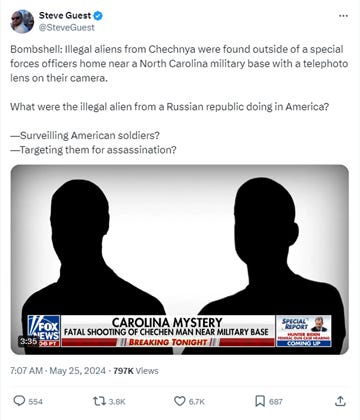
In one horrible case, national security paranoia about immigrant spies resulted in a death. Ramzan Daraev was a legal immigrant from Chechnya in Russia who worked for Utilities One in Carthage, North Carolina. Daraev and his coworker Adsalam Dzhankutov were taking a survey of poles as part of an engineering project to build out fiber on May 3rd, 2024, mainly by taking pictures of telephone poles. One of the residents on the street where Daraev and his coworker were conducting the survey was a military colonel who was alarmed by the men and confronted them. It’s unclear exactly what argument or conflict happened at this point, but the colonel shot and killed Daraev.[42]
At first glance, this appears to be a misunderstanding or an argument that got out of hand. Many of us have been surprised by utility workers checking the meter on the side of our houses without first knocking on the door, so perhaps Daraev and Dzhankutov crossed the colonel’s property line without permission. Fox News reporter Jennifer Griffin and producer Liz Friden reported sources that told “Fox News that ‘power company employment is often a cover for status/action’ that U.S. intelligence agents use for surveillance of foreign targets overseas.”[43] They also wrote that “they did have two cell phones with Russian language contacts and camera equipment.” Who among us doesn’t have a phone with a camera in it? It’s also not unusual for immigrants from Russia to have Russian language contacts – it would be weird if they didn’t.
Reason journalist Matthew Petti wrote that a former Senator Ted Cruz staffer retweeted the story with the comment about how Daraev was an illegal immigrant and questioning why they were in the United States, and whether he was surveilling American soldiers or targeting them for assassination.[44] Another example of “just asking questions.” The Fox News story was later updated with an acknowledgment that Daraev’s immigration status was not confirmed, but his family did show the reporters US government immigration documents that stated he was in the country legally. There is no evidence that Daraev was a spy.[45] Shooting first and “just asking questions” later is not an effective counterespionage strategy, but it will get you sympathetic coverage on Fox News.
American Businesses Think the Risk of Espionage is Worth the Reward of Hiring Immigrants
American businesses are the biggest victims of economic espionage. About 60 percent of the spies identified stole economic, industrial, or commercial secrets from businesses, not military secrets from the government. Economic espionage is lucrative because the information is financially valuable and often protected by intellectual property law, through the likes of trade secrets, patents, and copyrights. Intellectual property and trade secrets aim to incentivize research and development by giving the owners of the inventions a property right or monopoly. In theory, this is necessary because it can be cheap for competitors to copy the innovations that were expensive to develop without infringing on the traditional property rights of the inventor.
A thief infringes on your property rights when he steals your car because you can’t use the car even though you have a legal property right in it. When somebody steals your knowledge of how to bake blueberry muffins or make a nuclear bomb, you can still bake delicious muffins or threaten Armageddon, but the profits may be lower, and you probably have less of an incentive to discover the recipes in the first place. The society-wide effect could be less innovation overall, and we’d all suffer – perhaps not as much as if there were no property rights in automobiles, but we’d be poorer than we otherwise would be.
Some economists think the government goes too far in protecting intellectual property because too much protection actually disincentivizes more invention by allowing researchers to sit on their monopoly property rights while denying other researchers the use of knowledge to further innovate.[46] Imagine having an experimental recipe for an entirely new type of muffin, but you’re legally prohibited from trying it because the person who holds the patent for mixing sugar and flour doesn’t allow you to try. Ozempic may not be necessary in such a world, but baking innovation and our taste buds would suffer.
Those economists may have a good point in some cases, but when the research costs are high and the copying costs are low, it’s hard to see why firms would invest vast sums of money in innovating when competitors could just take the knowledge at a price of zero. Abolishing intellectual property and trade secret laws would probably result in a temporary frenzy of innovation and application of technologies currently owned by monopolists. Still, the hangover would likely reduce future innovation in at least some important sectors of the economy. The party would be fun, but the hangover would be permanent.
Or maybe not. Economist Alex Tabarrok and others doubt this for good reason, except in sectors where innovations are easy to copy and difficult to develop, like pharmaceuticals.[47] A better American intellectual property law would probably be confined entirely to pharmaceuticals. In that case, the wild party will never end, and nobody would wake up from a hangover like the East Germans did in the late 1980s.
A core function of the US government is to protect private property rights, even for trade secrets and other intellectual property. Xiaorong You stole valuable flavor-preserving chemical coating technology that infringed on the property rights of Dow Chemical, Sherwin-Williams, and other businesses. Since the government exists, in part, to protect private property, the government should protect that property by enforcing criminal laws. However, it’s doubtful American businesses want to go beyond normal criminal enforcement of intellectual property laws by limiting immigration. They think the risk of hiring foreign workers is worth the benefit. Since You was arrested in 2019, Dow Chemical, Sherwin Williams, and Coca-Cola have hired 282 temporary foreign-born skilled workers on the H-1B visa and sponsored many for green cards.[48]
If the costs of economic espionage committed by immigrants were high enough, then these firms wouldn’t hire foreign workers. In the same way the owners of cars are reluctant to park them in crime-ridden parts of American cities where they are more likely to be stolen, American firms with valuable trade secrets and intellectual property choose whom to hire based on the potential of the new employees to steal their valuable intellectual property. When a car owner chooses to park his car on the street, we can safely assume that he thinks the risk is worth the reward. We should do the same when evaluating the hiring choices of American firms with valuable intellectual property.
These firms may take extra precautions to protect against economic espionage such as better internal security, being more skeptical of hiring workers from some foreign countries, or closer cooperation with law enforcement, but their experience with You did not scare them off hiring skilled immigrant workers. They bear the costs of economic espionage, and they reap some of the rewards of hiring immigrant workers. These firms and others could just choose not to hire workers from abroad or to sponsor them for visas. Indeed, the point of onerous visa restrictions and high fees is to dissuade American firms from doing so.
When firms think the potential costs of hiring foreign workers are worth the benefits, then that is more important than all the combined statements of law enforcement and the government warning about Chinese espionage. After all, unlike the government, those firms pay the cost of being wrong. This is not an argument against intellectual property, nor is it an argument that law enforcement and prosecutors should stop pursuing economic espionage, but it is an argument for the government not restricting immigration to protect firms that voluntarily want to hire foreign workers. American firms know what the US government should: Immigrants aren’t coming to spy on you.
Read Part I, Part II, Part III, Part IV, Part V, Part VI, Part VII, Part IX, and Part X of What People Really Care About When They’re Mad About Immigration.
[1] Catherine Matacic, “Cold War espionage paid off—until it backfired, East German spy records reveal,” Science, July 31, 2017.
[2] Nicole Perlroth, “Accused of Spying for China, Until She Wasn’t,” The New York Times, May 9, 2015; and William W. Fick, Daniel N. Marx, and Amy Barsky to the U.S. District Court for the District of Massachusetts, “Memorandum in Support of Motion to Dismiss Indictment due to Unconstitutional Selective Enforcement and Prosecution,” United States v. Haoyang Yu et al., no. 19‐cr‐10195‐WGY, June 22, 2020.
[3] United States Department of Justice, “Information About the Department of Justice’s China Initiative and a Compilation of China-Related Prosecutions Since 2018,” U.S. Department of Justice Archives, last updated November 19, 2021; “Department of Justice China Initiative Fact Sheet,” Department of Justice.
[4] United States Department of Justice, “Information About the Department of Justice’s China Initiative and a Compilation of China-Related Prosecutions Since 2018,” U.S. Department of Justice Archives, last updated November 19, 2021.
[5] United States Attorney’s Office, Eastern District of Tennessee, “PH.D. Chemist Sentenced To 168 Months For Conspiracy To Steal Traded Secrets, Economic Espionage, Theft Of Trade Secrets, And Wire Fraud,” Department of Justice, May 9, 2022.
[6] United States Attorney’s Office, Eastern District of Tennessee, “PH.D. Chemist Sentenced To 168 Months For Conspiracy To Steal Traded Secrets, Economic Espionage, Theft Of Trade Secrets, And Wire Fraud,” Department of Justice, May 9, 2022.
[7] “GDP Growth (Annual %) - China,” World Bank Group.
[8] David M. Levy and Sandra J. Peart, “Soviet Growth & American Textbooks,” December 3, 2009.
[9] “International Labor Comparisons - Manufacturing in China,” US Bureau of Labor Statistics, last modified June 7, 2013; Judith Banister, “Manufacturing employment in China,” Monthly Labor Review, US Bureau of Labor Statistics, July 2005.
[10] Erica York and Alex Durante, “Trump Tariffs: Tracking the Economic Impact of the Trump Trade War,” Tax Foundation, September 5, 2025.
[11] Staff and agencies in Los Angeles, “Chinese thief of US military secrets given four years’ jail,” The Guardian, July 14, 2016.
[12] United States Attorney’s Office, Eastern District of Tennessee, “Former CIA Officer Sentenced to Prison for Espionage,” US Department of Justice, May 17, 2019; United States Department of Justice, Office Public Affairs, “Jury Convicts Former CIA Officer of Espionage,” US Department of Justice, June 8, 2018.
[13] United States Department of Justice, Office Public Affairs, “Chinese National Sentenced to Prison for Conspiracy to Steal Trade Secrets,” US Department of Justice, October 5, 2016.
[14] United States Department of Justice, Office Public Affairs, “Chinese National Sentenced to Prison for Conspiracy to Steal Trade Secrets,” US Department of Justice, October 5, 2016; United States District Court, Southern District of Iowa, United States of America v. Mo Hailong, Case No. 4:13-CR-147, Plea Agreement, January 27, 2016.
[15] United States Attorney’s Office, Northern District of California, “Four Executives Of Bay Area Semiconductor Equipment Manufacturer Charged In Alleged Conspiracy To Steal Technology And Related Crimes,” US Department of Justice, December 6, 2017.
[16] “Jury Convicts Ex-Employee in Tech Trade Secret Theft Case,” Digital Guardian (blog), September 13, 2021.
[17] United States Department of Justice, “Information About the Department of Justice’s China Initiative and a Compilation of China-Related Prosecutions Since 2018,” U.S. Department of Justice Archives, last updated November 19, 2021
[18] William P. Barr, “Transcript of Attorney General Barr’s Remarks on China Policy at the Gerald R. Ford Presidential Museum,” US Department of Justice Archives, July 17, 2020.
[19] Gus W. Weiss, “Duping the Soviets: The Farewell Dossier,” Central Intelligence Agency, April 14, 2007; and Soviet Acquisition of Western Technology (Washington: Central Intelligence Agency, April 1982).
[20] Economic Espionage Act of 1996, Pub. L. No. 104-294, 110 Stat. 3488 (Oct 11, 1996).
[21] Gus W. Weiss, “Duping the Soviets: The Farewell Dossier,” Central Intelligence Agency, April 14, 2007; and Soviet Acquisition of Western Technology (Washington: Central Intelligence Agency, April 1982).
[22] Albrecht Glitz and Erik Meyersson, “Industrial Espionage and Productivity,” American Economic Review 110, no. 4 (April 2020): 1055–1103; Alex Nowrasteh, “Espionage, Espionage-Related Crimes, and Immigration: A Risk Analysis, 1990–2019,” Cato Institute Policy Analysis No. 909, February 9, 2021.
[23] Catherine Matacic, “Cold War espionage paid off—until it backfired, East German spy records reveal,” Science, July 31, 2017.
[24] Albrecht Glitz and Erik Meyersson, “Industrial Espionage and Productivity,” American Economic Review 110, no. 4 (April 2020): 1055–1103.
[25] Kristie Macrakis, “Does Effective Espionage Lead to Success in Science and Technology? Lessons from the East German Ministry for State Security,” Intelligence and National Security 19, no. 1 (March 2004): 52–77.
[26] United States Department of Justice, Office Public Affairs, “Maryland Nuclear Engineer and Wife Sentenced for Espionage-Related Offenses,” US Department of Justice, November 9, 2022.
[27] Maya Yang, “Brazil was alleged intended recipient of US couple’s nuclear submarine secrets,” The Guardian, March 16, 2022.
[28] United States Department of Justice, Office Public Affairs, “Former Boeing Engineer Convicted of Economic Espionage in Theft of Space Shuttle Secrets for China,” US Department of Justice Archives, July 16, 2009.
[29] United States v. Dongfan “Greg” Chung, Case No. SACR 08-00024-CJC, Memorandum of Decision, United States District Court for the Central District of California, Southern Division, filed July 16, 2009.
[30] Nicole Perlroth, “Accused of Spying for China, Until She Wasn’t,” The New York Times, May 9, 2015; and William W. Fick, Daniel N. Marx, and Amy Barsky to the U.S. District Court for the District of Massachusetts, “Memorandum in Support of Motion to Dismiss Indictment due to Unconstitutional Selective Enforcement and Prosecution,” United States v. Haoyang Yu et al., no. 19‐cr‐10195‐WGY, June 22, 2020.
[31] “Xi v. United States – Challenge to Warrantless Surveillance,” American Civil Liberties Union, last updated May 24, 2023.
[32] Neil G. Ruiz, Carolyn Im, Christine Huang, and Laura Silver, “Most Asian Americans View Their Ancestral Homelands Favorably, Except Chinese Americans,” Pew Research Center, July 19, 2023.
[33] Alex Nowrasteh, “Espionage, Espionage-Related Crimes, and Immigration: A Risk Analysis, 1990–2019,” Cato Institute Policy Analysis No. 909, August 22, 2023.
[34] United States Attorney’s Office, Northern District of West Virginia, “Former West Virginia University professor sentenced for fraud that enabled him to participate in the People’s Republic of China’s ‘Thousand Talents Plan’,” US Department of Justice, July 30, 2020.
[35] United States Attorney’s Office, Southern District of Ohio, “University researcher pleads guilty to lying on grant applications to develop scientific expertise for China,” US Department of Justice, November 12, 2020.
[36] United States Attorney’s Office, Northern District of Georgia, “Former Emory University professor and Chinese ‘Thousand Talents’ participant convicted and sentenced for filing a false tax return,” US Department of Justice, May 11, 2020.
[37] United States Attorney’s Office, Northern District of Georgia, “Former Emory University professor and Chinese ‘Thousand Talents’ participant convicted and sentenced for filing a false tax return,” US Department of Justice, May 11, 2020.
[38] James Andrew Lewis, interview by John C. Demers, “Online Event: Countering Chinese Espionage,” Center for Strategic & International Studies, August 12, 2020.
[39] United States Attorney’s Office, Central District of California, “Glendale Man Who Stole and Distributed Trade Secrets Belonging to Former Employer Sentenced to One Year in Federal Prison,” US Department of Justice, June 6, 2016.
[40] Alene Tchekmedyian, “Glendale man convicted of sending trade secrets to former employer’s competitors,” Los Angeles Times, January 7, 2016.
[41] Daniela Ibarra, “California engineer admits to running San Antonio brothel, federal court records say,” KSAT.com, July 25, 2023.
[42] Matthew Petti, “When a North Carolina Colonel Shot This Utility Worker, Journalists Suggested His Victim Was a Spy,” Reason, June 6, 2024.
[43] Jennifer Griffin and Liz Friden, “Mysterious shooting outside Army Special Forces residence in North Carolina raises questions,” Fox News, May 23, 2024.
[44] Steve Guest (@SteveGuest), “Bombshell: Illegal Aliens from Chechnya Were Found outside of a Special Forces Officers Home near a North Carolina Military Base with a Telephoto Lens on Their Camera,” X, May 25, 2024, 7:07 a.m.
[45] Matthew Kupfer (@Matthew_Kupfer), “Thread: Update on the Killing of Ramzan Daraev, a Chechen Immigrant from Russia Who Was Shot by a US Serviceperson in North Carolina,” X post, June 6, 2024, 2:06 p.m.
[46] Michele Boldrin and David K. Levine, Against Intellectual Monopoly (Cambridge: Cambridge University Press, 2008).
[47] Alex Tabarrok, Launching The Innovation Renaissance: A New Path to Bring Smart Ideas to Market Fast (TED Books, 2011).
[48] U.S. Citizenship and Immigration Services, “H-1B Employer Data Hub,” last updated June 30, 2025.