

Nationalist politicians have had a decade of political successes and policy disasters around the world. Nationalists support sovereignty, increased social cohesion and trust, traditional culture, and big fuzzy feelings among conationals. Those modest proposed benefits must be compared to the costs to see if nationalism is worth taking a risk on, particularly the biggest potential downside costs. Do vague magic words justify the risk of giving a nationalist strongman control over your government? Let’s find out.
Nationalism is a statist ideology rooted in elevating tribal power rather than protecting individual rights. The term itself comes from natio, a feminine Latin noun that means ethnicity or a race of people, which is how it’s understood outside the United States and why Americans often misinterpret it as intensified patriotism. At its core, nationalism elevates an ethnic group’s powers over individual liberty and treats the nation as the sole important unit in society. Nationalist governments exist to represent the nation and preserve and extend the culture and interests of the national dominant group by force.
Modern nationalists tend to favor trade restrictions, closed borders, political control over capital flows, the nationalization of industries, centralized graft, and other collectivist economic policies. The theoretical arguments against those policies are supported by an empirical track record that would make all but the most shameless blush. Compared to the costs that follow, those economic costs are the smallest.

A key tenet of nationalism is that foreign ideas, inputs, and opinions are unwelcome. They pollute the pure nation and distract it from self-improvement. The only resolutions to social problems are those that arise from within the nation, while, at best, foreign ideas are suspicious, icky, and unlikely to work. At worst, foreign ideas are intended to undermine and destroy the nation. A society this close-minded can succumb to serious, costly, and incurable groupthink. Every society and group falls prey to some degree of groupthink, but the costs are smaller if people can change groups, are exposed to new ideas, and do not feel restricted in adopting good ideas regardless of where they originate. Nationalists preclude such adaptation and so fail to correct errors, don’t innovate, and respond poorly to crises.
Nations are “historically novel entities pretending to have existed for a very long time,” according to Ernest Renan, and based on common ethnicity, according to Azar Gat. As Ernest Gellner put it, “nationalism is not the awakening of nations to self-consciousness: it invents nations where they do not exist.” Renan wrote that “the essence of a nation is that all its members have a great amount in common, and also that they have all forgotten a great deal.” The nationlist project is therefore a busy endeavor.
Expanding upon or building a nation requires assimilating non-nationals against their will, expelling those who cannot or will not assimilate, and discriminating against or slaughtering those who remain. The late historian Aristide Zollberg called this a “refugee-generating process.” Mass population movements in Europe, the partition of India, Africa, and other locations are evidence of this. Unless you’re an extreme relativist who thinks that non-nationals are ethically or morally worth less than the members of your political tribe, creating refugees is a terrible cost of nationalism.
Nationalist governments also frequently commit genocide. Nationalists killed about 92 million people from the late 19th century to the end of the 20th, according to calculations by the late political scientist RJ Rummel. That body count is second only to communism. Not every nationalist government committed or attempted to murder millions of people, but many did and they succeeded. We rightly criticize today’s communists for believing in an ideology whose historical practitioners killed about 150 million people in the 20th century when they took power. So, when are we going to criticize nationalists today for believing an ideology that inspired a similar-scale slaughter? Nationalists and communists today should at least have to explain how they won’t slaughter millions of people if we trust them with power again.
This new age of nationalism correlates with more wars just like the last surge of nationalism. Perhaps this is endogenous, and governments or populations desiring more war lead to a rise in nationalism there and in response overseas, but even so, it’s revealing that politicians and voters reach for nationalism when war is more likely. That’s not what would happen if nationalism were an ideology that was more likely than not to staunch conflicts between countries. The history here is long.
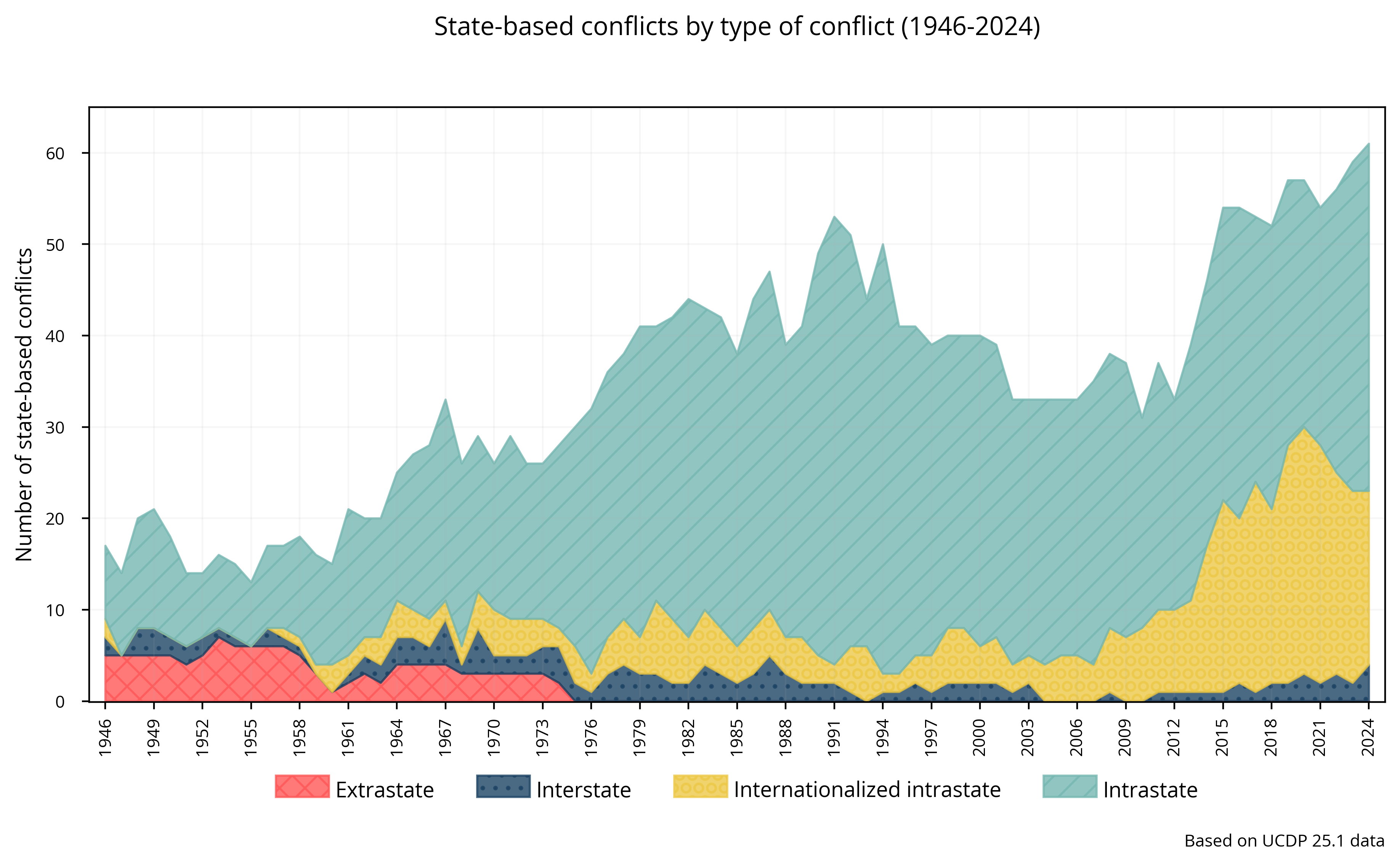
Periods of intense nationalist mobilization have coincided with sharp increases in interstate conflict. Nationalism is the ideology foremost responsible for World War I and World War II. Ethnic affinities across borders, the creation of new nationalities by political entrepreneurs, foolish notions of national pride reflected by a willingness to hurl conscript armies at each other, the desire to recapture ancestral homelands, and obsessions with living space for one’s own tribe all influenced these ideological conflicts. Wars don’t require ideologies and the deadliest wars that killed the greatest percentage of the world’s population were non-ideological. But the two deadliest wars of the 20th century were nationalist conflicts that reshaped much of the world. The major military conflict of today is Russia’s revanchist invasion of Ukraine to reconstitute the Russian Empire by bringing the “fake Ukrainian ethnicity back into the fold. Historian Douglas Porch noted, “Colonialism was not, as Lenin claimed, ‘the highest stage of capitalism.’ Rather, it was the highest stage of nationalism.”
Nationalists around the world admired Putin before he ordered the invasion of Ukraine. His international fanbase of nationalist sympathizers included Dutch nationalist Thierry Baudet, French nationalist Marine Le Pen, Italian nationalist and Prime Minister Georgia Meloni, former Italian Prime Minister Berlusconi, and many American nationalists like Tucker Carlson who marveled at Russian shopping cart technology. Nationalists of the world, unite! Many foreign nationalists in Europe initially praised President Donald Trump’s removal of Venezuela’s Maduro until Trump restarted his potentially hostile agitation to acquire Greenland from Denmark. Nationalists of the world, opposed!
Those European nationalists should not have been surprised in the least but, like usual, this is just more evidence that everything in Europe runs a little slower. Although European nationalists also spread the obvious empirical falsehood that nationalists are peaceniks who abhor war, I assumed they were fibbing or concern trolling. Turns out they really believed that their side was pro-peace because they opposed Ukraine resisting Russia’s invasion. There may also be an ideological reason. The nationalist theorist Anthony Smith wrote that there are four characteristics of nationalism:
The world is divided into nations, each with its own individuality, history and destiny.
The nation is the source of all political and social power, and loyalty to the nation overrides all other allegiances.
Human beings must identify with a nation if they want to be free and realize themselves.
Nations must be free and secure if peace and justice are to prevail in the world.
Nationalists like Yoram Hazony use a similar proposition to claim that no true nation or nationalist regime could be a warmonger because of this or similar definitions. Ignoring real nationalists and Hazony’s own foreign policy opinions for a second, let’s assume those four points are a good guide to understanding nationalism. The obvious response is that some national governments will see their destiny as militarily dominating or conquering other nations (point 1), not all nations will be recognized by other nations as real nations (points 2 to 4), and some nations will demand land from others to feel secure (point 4). Just like the United States is demanding Greenland from Denmark to feel secure. Only then will peace and justice prevail, until another nationalist government demands territory from another to feel secure. The world could be entirely populated by nations that achieve points 1 to 3 peacefully, and quote Hazony or Smith as if they were Thomas Jefferson or James Madison, and still be in constant war with each other because they desire each other’s territory to feel secure and to achieve justice. And on it goes.
This is what the more intellectually grounded nationalists think. I’m not joking or cherry-picking quotes intended to tarnish them. I wish I were because the world would be less unstable then.
We can’t trust nationalists to abandon their proud tradition of starting wars, genocides, xenophobia, or pursuing anti-market policies. Considering those risks and their extremely high costs, the nationalists offer mostly gobbledygook like sovereignty, social cohesion and trust, a stable traditional culture, and the warm glow of collectivist feelings like we’re one big happy family. There’s no serious threat to sovereignty besides other nationalist governments. Social trust doesn’t affect economic growth and may not even be a real measure in the first place. There’s not an obvious relationship between nationalism and stability. The record of governments centrally planning culture isn’t too rosy there, comrade culture warrior. At least the communists promised material abundance. Try getting a mortgage with the fuzzy feelings of national solidarity as collateral.
Even if nationalist governments could increase your fuzzy feelings toward strangers, it’s not worth the downsides because there are many other cheaper ways to get there that don’t increase the risk of war or genocide. For instance, allow freedom of religion so people can find spiritual solace where they want. Let people form the families they want. Allow freedom of association so that people can interact as they wish, forming meaningful bonds with those they personally know. Embrace free enterprise to foster economic growth and enhance material well-being. But for Pete’s sake, don’t embrace a political ideology with a body count second only to communism.
It’s tempting to think of nationalism as blubbering sentimentalism felt by people who spend too much time looking at maps, getting mad at conflicts that ended centuries ago, and disliking foreigners. Resist that temptation in the same way you’d resist thinking of communists as people who just want to share. Politicians deranged by the ideology of nationalism rest atop the heads of nuclear-armed states. That’s the highest existential risk in the world today.
"A key tenet of nationalism is that foreign ideas, inputs, and opinions are unwelcome. They pollute the pure nation and distract it from self-improvement. The only resolutions to social problems are those that arise from within the nation, while, at best, foreign ideas are suspicious, icky, and unlikely to work. At worst, foreign ideas are intended to undermine and destroy the nation."
This is correct. The MAGA ideology is an extremely simple obsession with borders. It can be summed up as follows: Everything outside the border is bad. Everything within the border is good. If something within the border is bad, however, then it must have come from the outside.
Reasoning from there, we find justifications for: mass deportations, travel bans, arbitrary immigration restrictions, tariffs, and other trade barriers.
To be clear, some of the MAGA policy moves are just fine on their own. However, because they are rooted in this simple, absolute ideology, rational policy moves will never be enough; they will never be sufficient.
It will never be enough to crack down on illegal immigration, for example, or on quasi-legal asylum claims, which is why the administration nearly banned legal refugees and is steadily making it harder and harder to immigrate legally.
That will also never be enough, which is why the administration is pivoting to blanket travel bans for temporary visitors as well: a gradual backdoor rewrite of immigration law via executive order.
But understand that this, too, will never be enough, so next in line for deportation will be legal immigrants, followed swiftly by naturalized citizens.
A minor quibble: I do not believe this is an exercise in “self-improvement.” Rather, it’s an appeal to nostalgia, a false conception of how “great” America used to be. It’s not a forward-looking mindset, its backward looking.
It’s a decel, not accel.
This is really powerful work, Alex. The way you connect the abstract “fuzzy” promises of nationalism to concrete downside risks—refugee‑generation, genocide, and a higher propensity for interstate war—forces readers to confront the actual historical track record rather than vibes.
The groupthink point landed especially hard for me: once foreign ideas and people are treated as pollution, you don’t just get uglier rhetoric, you get a polity that literally can’t update when reality changes. That’s exactly why the same ideology that cheers “sovereignty” and “social cohesion” also keeps reaching for trade barriers, border closures, and cultural central planning, even when those tools are obviously self‑destructive.
What I’d love to see more people on the right grapple with is your core risk argument: even if you think nationalism occasionally delivers short‑run policy wins, you’re buying them with a tail risk that includes mass expulsions, great‑power war, and leaders who view nuclear weapons as tools of tribal destiny. That’s a terrible trade when there are cheaper ways—religious freedom, open association, liberal markets—to get whatever “social cohesion” is actually worth having.