

How long does it take a sibling of a U.S. citizen to get a green card from Mexico? A couple of years ago a YouGov poll asked a nationally representative sample of a thousand Americans this question. Half said less than a year. Another quarter said between one and three years. Only 1% got the right answer: more than fifteen years.
When asked how long the process should take, 66% of Republicans, 65% of Independents, and 72% of Democrats said under a year. In other words, the immigration system that even the modal Republican voter wants is far less restrictive than the one the United States already has. They just have no idea how difficult and restrictive the existing immigration system already is. These results motivated us to study the issue more carefully.
As researchers who study immigration policy and public opinion, we hear some version of “I support legal immigration” all the time. It is one of the most common things Americans say when the topic comes up. Unfortunately, the people who say it usually cannot explain what legal immigration actually involves: the nearly two hundred visa categories, the decades-long backlogs, the $1,140 application fee for a green card (before thousands more in legal fees), or the 75-country travel ban that now bars a quarter of the world’s population from most visa categories. That is not the fault of prospective immigrants. The system is genuinely hard to understand, even for graduate-level trained immigration researchers like us.
Take immediate migration for spouses of US citizens, which is about as close to a slam dunk in terms of public support as immigration policy gets. Almost nobody opposes letting citizens bring their husband or wife to the country. Despite its popularity, the process takes 12 to 18 months, costs thousands in fees, and involves mountains of paperwork. Learning about these delays angers even the harshest critics of current immigration levels, including supporters of President Trump (who has famously married several immigrants himself). If the system is this difficult for spouses, imagine what it looks like for everyone else.
The gap between what people think the system looks like and what it actually looks like has real consequences for the debate.
Almost nobody knows how the system works
We tested this phenomenon more systematically in our paper, recently published in the Journal of Experimental Political Science. In our survey of 1,000 Americans, we asked respondents how long it would take various types of people to legally immigrate. We also asked whether certain family members are even eligible. The average respondent got 25% of the questions right, barely above the 20% you’d expect from random guessing. For example, only about 8% correctly identified that aunts and uncles of U.S. citizens are not eligible to immigrate at all.
The ignorance was remarkably uniform. Young and old, rich and poor, college-educated and not, Democrat and Republican: none of these groups performed meaningfully better than any other. Republicans were, if anything, slightly less likely to know the rules, though the differences were small. The point is not to single anyone out. Almost everyone is in the dark.
This should not be surprising. Alex Nowrasteh and David Bier at the Cato Institute have spent years documenting just how byzantine the system is. Their analysis found that fewer than 1% of people who want to move permanently to the United States can do so legally. They also created the Green Card Game, an online simulation that lets you try to work through the actual rules. Most players discover that there is no “line” to get into, or that the line they’d be placed in lasts longer than a human lifetime. Our research was directly inspired by their work, and we wanted to test whether learning about these realities actually changes people’s minds.
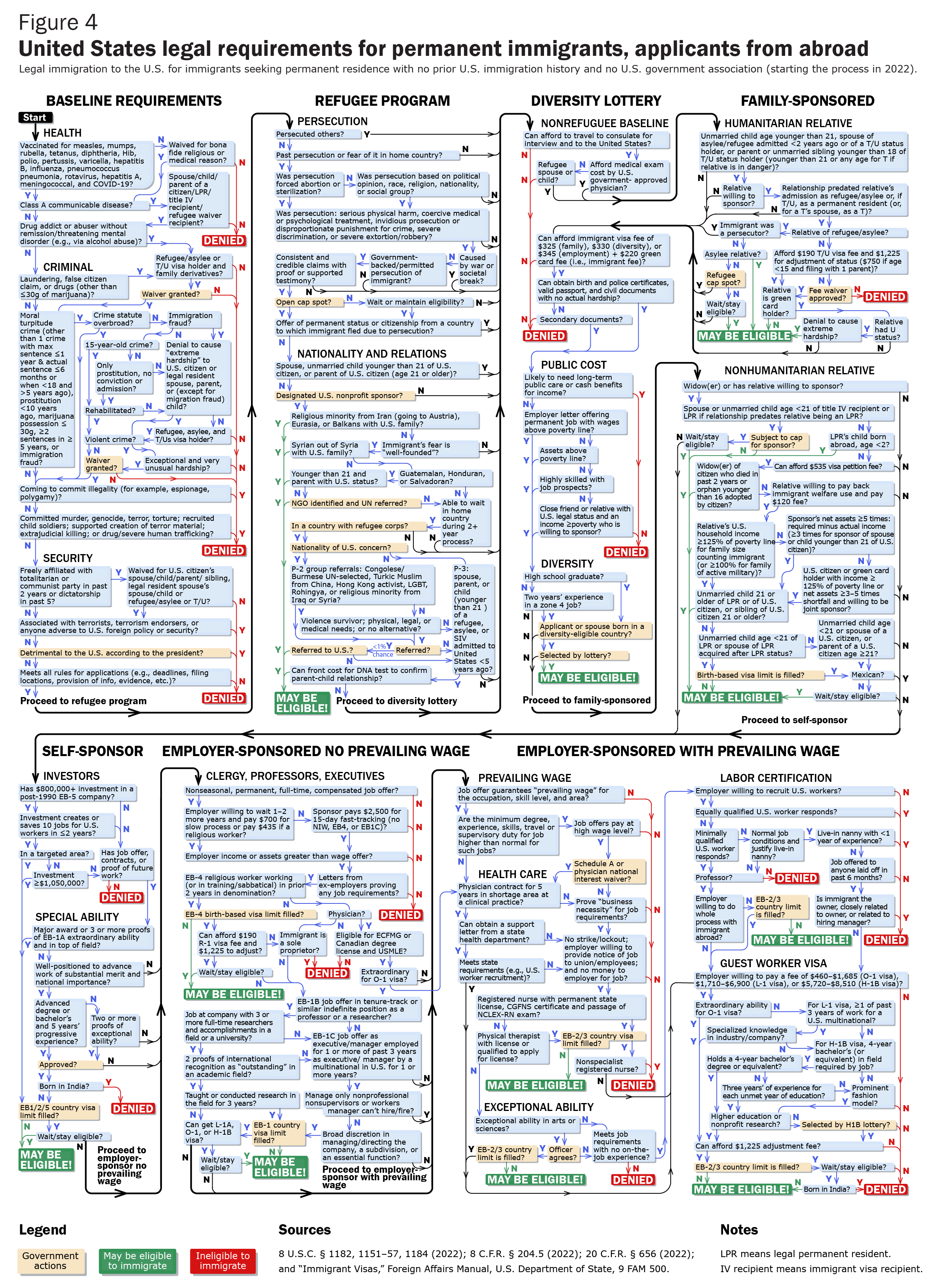
Telling people the truth moves opinion
We are generally skeptical that information alone changes political attitudes. On most issues, people already know what they want to believe, and new facts get filtered through existing priors. But immigration policy might be different, precisely because the knowledge gap is so enormous. People are not filtering out inconvenient truths. They simply have no idea what the current rules are.
To test this, we randomly assigned respondents to read one of two short paragraphs: one describing how burdensome the system is (costs, wait times, complexity) and another describing how restrictive it is (numerical caps, country quotas, multi-decade backlogs). A control group read a neutral paragraph about migration definitions.
Both treatments worked. Respondents who learned about the system were 13 percentage points more likely to say they preferred increasing legal immigration or making the process easier. That is a large effect for a survey experiment, roughly a 35% increase over the baseline. And the shift was not limited to Democrats. It showed up across the political spectrum, including among Republicans and self-identified conservatives.
Why did it work? We think it is because the information was relevant to what people already care about. Telling people “immigrants are good” is unlikely to move many minds because it runs into existing beliefs and identities. Telling people “the system you think you support is actually far more restrictive than you realize” is a different kind of message. It speaks to voters’ own preferences rather than trying to override them.
What this means
We should be clear about what this does and does not show. A one-shot survey experiment cannot tell us whether these effects last, or whether they survive the counter-messaging that voters encounter in real political campaigns. We also studied legal immigration specifically, not the broader debate about border security or unauthorized migration, which triggers different reactions. We are now working on a larger follow-up study across multiple countries to test whether the effects hold up over time, whether they extend to attitudes about unauthorized immigration and naturalization, and whether some groups (such as moderates and conservatives) are more persuadable than others.
But the finding already points to something practically useful. Most Americans, across the political spectrum, want a legal immigration system that is faster and simpler than the one they have. They do not know that the current system already fails to meet their own standards. That gap is an opportunity, both for changing minds and for changing policy.
For those who want to make immigration more politically sustainable, the lesson is that persuasion works best when it is about things people care about but don’t yet know. Generic appeals to the benefits of diversity or immigrant contributions are easy to dismiss. Concrete facts about wait times, costs, and eligibility rules are harder to argue with because they speak to the voter’s own sense of fairness.
The best outcome, of course, would be to actually make legal immigration less difficult rather than simply informing people that it is difficult. But the latter may be important for the former. When voters learn that the system is more restrictive than what they want, the political space for reform expands. Spread the word.
Alexander Kustov is an associate professor at the University of Notre Dame’s Keough School of Global Affairs and the author of In Our Interest: How Democracies Can Make Immigration Popular (Columbia University Press, 2025). Michelangelo Landgrave is a faculty member in the Department of Political Science at the University of Colorado. Their paper “Immigration is Difficult?!” was published in the Journal of Experimental Political Science in 2025.

I've been trying to tell this to people for years. Im a minister who was involved in the process of helping a minister from another western country get approval to pastor a church. The church hired an immigration lawyer. At one point when months had passed I asked the lawyer how much longer it would take to get the ministers visa. She said "Three more months". When I reacted as one might expect she said, "Oh wait. You paid the fee for an expedited visa. It will take three weeks." It was then that I realized four things: (1) in some nations you'd have to bribe somebody to get in; we bribe the government (2) if it takes a lawyer to smooth the skids, some poor guy in Mexico has no chance (3) I'm glad my ancestors came over when all you had to do was survive the voyage (4) our immigration system is in desperate need of a fix.
so much waste here and it's worse now with all of the attacks on immigrants from the government side. It's sad how complex this system is: it's no wonder undocumented arrivals happen all the time. Thanks for all your work on this topic.