


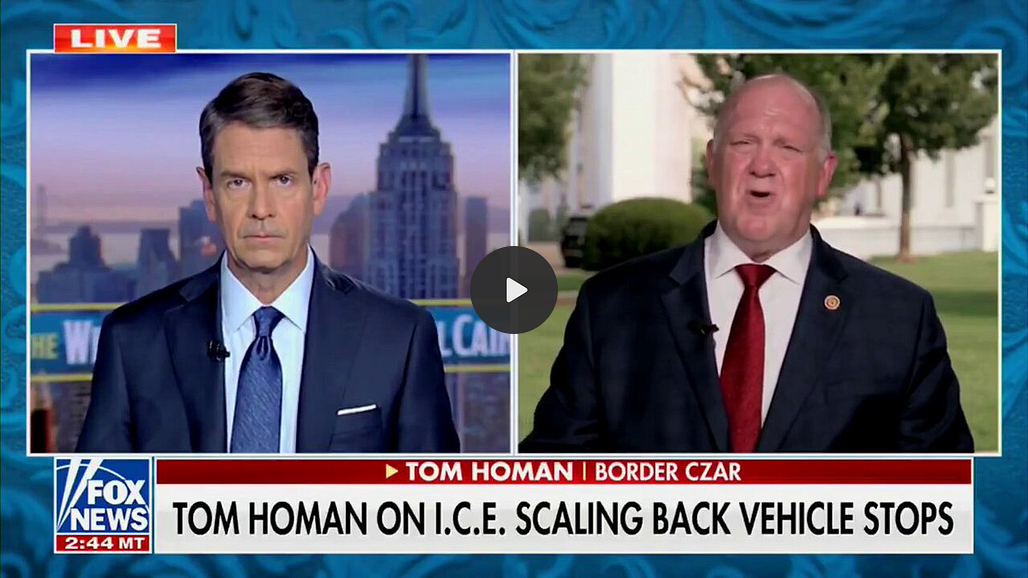
I have an op-ed on President Trump’s order to restart ICE traffic stops in which I explain why they are happening, why they are dangerous, and why they’re unnecessary.
Here’s an excerpt:
It’s true that ICE officers receive less training on vehicle stops. That’s because, before this administration, most arrestees came straight from federal, state or local custody, and when ICE had to go to the streets, it carefully planned operations — surveilling suspects to learn their routines, sometimes for weeks, and working as a team of agents and creating a pre-enforcement action plan.
To speed up arrests, however, ICE reportedly eliminated the pre-enforcement planning last year as it started targeting areas more than specific people. “It’s hard to fill out a worksheet that just says, ‘Meet in the Home Depot parking lot,’” one former ICE official told NBC News. Enforcement went from targeted and planned to indiscriminate and opportunistic, which led to more chaotic interactions.
Reflecting this lack of planning, both of the immigrants shot and killed in the past two weeks were not the individuals ICE agents were originally looking to arrest, according to lawmakers who spoke to officials. A similar situation played out in Minnesota earlier this year, when ICE agents mistook a DoorDash driver for their target before shooting him after he ran into his home. (That officer was charged after video evidence from a city traffic camera contradicted his account.)
Even when pre-arrest surveillance of a specific suspect is conducted, ICE agents appear to relish the car chases and often fail to stop the suspect before they drive away. One Department of Homeland Security supervisor described the attitude to The New York Times as “we’re adrenaline junkies who want action, foot chases, car pursuits.”
In October 2025, for instance, agents waited outside the home of Carlitos Ricardo Parias, a TikTok influencer, whom ICE was particularly interested in arresting. But rather than leap immediately into action, they let him get into his car. This led to a vehicle stop at which an ICE agent shot Parias, and the bullet ricocheted into a U.S. marshal.
Another shooting in California in April 2026 followed the same pattern. ICE did the surveillance but let the suspect get into their car. This appears to have been intentional. In June, surveillance video captured what appears to be a targeted ICE arrest in Milwaukee, in which officers allowed the suspect several minutes to get a snack and re-enter his vehicle before the team moved in for the arrest.
When stops do happen, as a Wall Street Journal investigation found earlier this year, ICE agents commonly use tactics that place themselves in unnecessary risk: failing to tell drivers to turn off their engines, grabbing cars when they start to move, placing their bodies — rather than vehicles — in the way, and then shooting at uncooperative drivers.
I conclude:
On Fox News Tuesday, White House border czar Homan admitted that there’s no downside to ending vehicle stops. “I hear a lot of noise right now, ‘this will affect ICE arrests.’ It’s not going to,” he said. “Before he gets into the car, you can arrest him then. You can wait until the vehicle gets to its destination,” he said — unless the target is a violent criminal. He added, “If we can take that 2-ton ‘weapon’ away from them, that’s good.”
Homan is admitting what the record shows: ICE has been endangering its officers and others for no enforcement benefit. Ending vehicle stops won’t end all the problems, or even all the deaths. But continuing them means more danger for ICE personnel and the public.
You can read the entire piece here: Trump’s order to resume ICE traffic stops means more danger for the public